

Key Takeaways
- A percentage-of-collections model means the billing company is paid a set share of the money it actually collects for you, so it earns nothing on claims that don't pay.
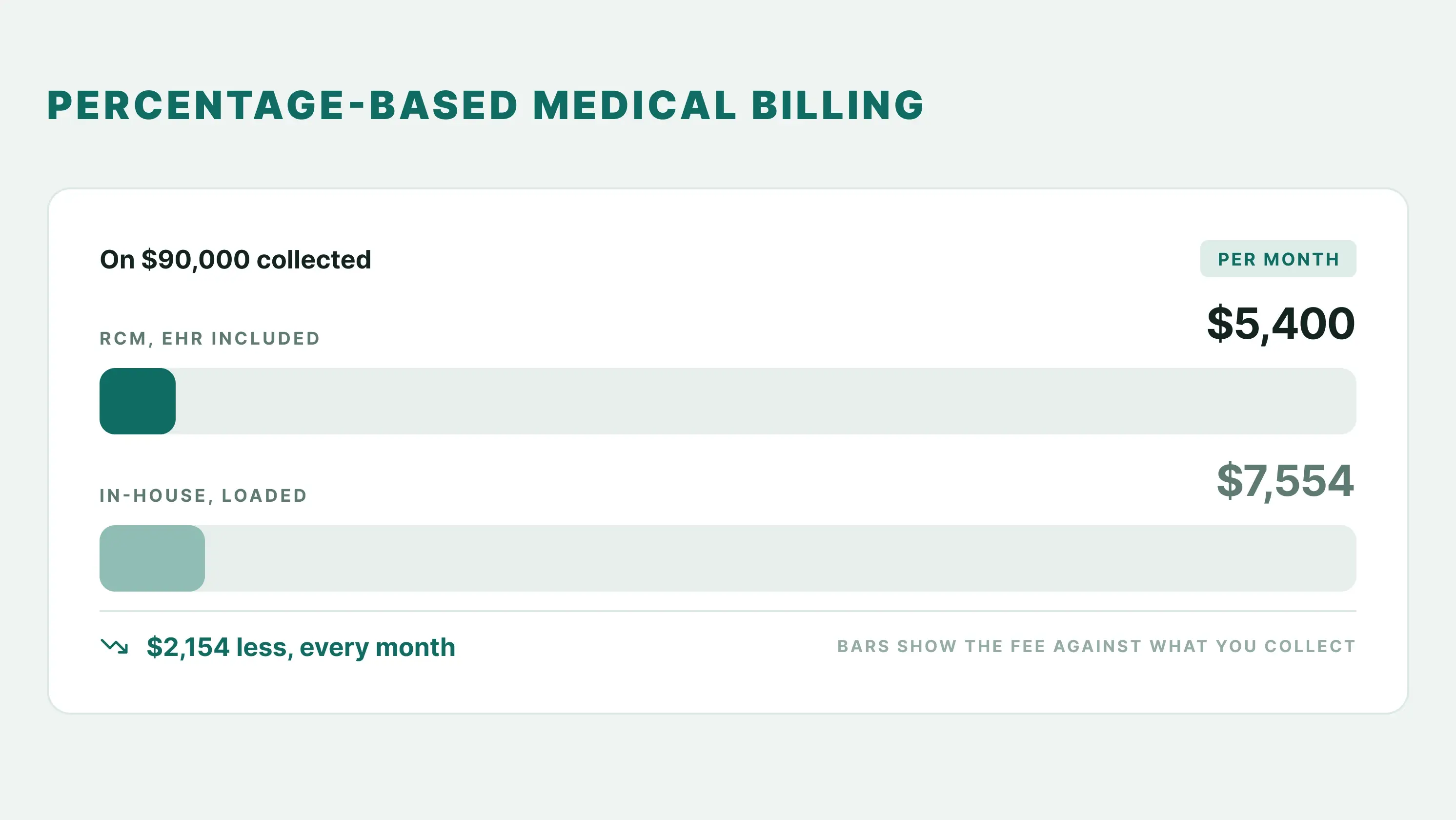
- For a three-provider practice collecting $90,000 a month, in-house billing runs about $90,650 a year, or 8.4% of collections.
- A percentage that includes the EHR beats a billing company plus a separate EHR unless that company charges under roughly 4.5%. At very high collections, one in-house biller can cost less on paper.
Think of a three-provider family medicine practice that collects $90,000 a month. The owner has two quotes on the desk, one from a billing company at a percentage and one from a vendor selling software so her front desk can bill in-house.
Whether a medical billing percentage of collections is worth paying comes down to five numbers from your own books and about ten minutes of math.
For a small practice, a percentage usually wins. It stops winning at a collections level you can calculate, and the math below shows where. Every input below is an example, so swap in yours.
What Percentage of Collections Do Medical Billing Companies Charge?
Most published sources put medical billing service rates at 4% to 10% of collections. Those sources are mostly billing vendors, so read the range as what billing companies report, not an industry average. The one sampled number is Tebra's survey of 190 billing companies, which found 63% charge 7.99% or less.
The same survey found 28% of billing companies use a model that isn't a percentage. Small practices tend to land higher in the range, and many companies set a monthly minimum, so a very small practice can pay more than the headline rate.
So how much do medical billing companies charge? It's a range, and where you land depends on your size, your specialty, and what the percentage covers. That last part matters more than the rate itself.
Percentage vs Flat Fee for Medical Billing Services
A percentage ties the company's pay to your cash. A flat fee ties it to the work, whether or not the claims pay. Neither is always cheaper, and anyone who says otherwise is selling one of them.
A percentage rewards the company for chasing a denied claim, because it gets paid only when the claim does. It also costs more as your collections grow, even if the workload doesn't. A 5% fee on $1 million in collections is $50,000, and on $2 million it's $100,000.
A flat fee gives you a predictable bill and can win when your claims are large, such as surgical or orthopedic work. The risk on that side is that the company is paid at submission, so nothing in the price pushes it to work a denial for months.
Take two practices.
- A family medicine office collects about $110 on an average claim, so a percentage stays small on each one and the biller has every reason to keep the claims flowing.
- An orthopedic group collects $620 on an average claim, and one billing vendor's math shows 6% of that is $37 a claim against a flat $6, so the flat fee wins there. Modest claim sizes favor a percentage, and a few very high-dollar claims a day call for pricing a flat fee too.
The Cost of In-House Medical Billing
In-house billing costs more than the biller's wage. A biller you hire costs about $74,450 a year before software, and that figure doesn't count the denials nobody has time to work.
The wage is $47,120, the median for medical records specialists in physician offices in May 2025, according to the Bureau of Labor Statistics. The Bureau doesn't publish a line for billers, so this is the closest category. Taxes, benefits, and time-off coverage add to that. The 1.58 multiplier comes from a billing vendor's worked example, which is a vendor's figure, so use your own payroll numbers if you have them.
That biller also needs EHR and practice management software before a claim can go out. Published guides from EHR vendors, and our own EHR cost guide, put cloud EHRs for small practices at $200 to $700 per provider per month.
The table uses the $450 midpoint, and add-ons such as telehealth, a patient portal, and a scribe usually cost extra, so the real number runs higher. The scenario is a three-provider practice collecting $90,000 a month, or $1,080,000 a year.
To run your own, replace the wage, the multiplier, the software price, the provider count, and the collections figure. The table also leaves out the cost of denials nobody works.
MGMA's January 2026 poll found 48% of leaders named denials and appeals as their top source of revenue leakage, with first-submission denial rates of 7% to 8%. The real in-house number is higher than the table shows.
In-House vs Outsourced Medical Billing Cost
Outsourced medical billing costs less than in-house billing when the company's percentage is below your in-house total as a share of collections. For the practice above, that line is 8.4%, and most published typical rates sit under it.
The harder comparison is between two kinds of outsourcing, and the wider decision is covered in the guide to in-house vs outsourced billing.
Say you hire a billing company and keep your own EHR. At the same $450 midpoint, that's $16,200 a year for three providers, on top of the company's percentage. Quote a different EHR and the number moves, so use its full price with the add-ons you'd need.
Now take a plan where one percentage covers the billing and the EHR comes with it at no extra cost. At 6%, this practice pays 6% x $1,080,000 = $64,800 a year. That's $25,850 less than doing it in-house, or 2.4 points of collections.
The math is quite simple. A separate billing company plus a separate EHR costs less only if it charges under about 4.5% of collections: ($64,800 minus $16,200) divided by $1,080,000 = 4.5%.
That line holds before you compare scope. A company that charges 4.5% and leaves credentialing, patient statements, and denial follow-up to you is a different offer from one that does the whole job.
What a Percentage Should Include
A percentage is only a good deal if you know what it covers. Before you sign, ask what the medical billing company fees include, because the surprises usually live outside the headline rate.
Ask five questions:
- Is the percentage on money collected, or on what you charged?
- Do patient payments you take at the front desk count?
- Is there a monthly minimum, and what is it?
- Is there a fee for setup, data migration, or working older denials?
- What do you still pay after you leave?
Some vendors also charge extra for data migration, analytics, and EHR integrations, and those add-ons can raise the total cost significantly.
There's one more concern, and it's a fair one. When a company earns a share of every claim, a bad actor has a reason to code higher than the visit supports. You can't fully check that from a contract. You can check it by asking whether you can see your own claim data live, and whether a person reviews claims before they go out.
How PracticeEHR Packages Work
PracticeEHR offers billing and RCM services bundled with its EHR, for a small percentage of monthly revenue, with the EHR included at no extra cost. RCM stands for revenue cycle management, which here means we do the billing and you get paid. Payers pay your practice, and you pay us a percentage.
Our plans come in three shapes, and they map onto the three paths above:
- EHR only: Essential and Pro plans, $229 to $379 per provider per month, billed monthly.
- EHR + PM: the billing software, so your own staff bill, at $349 to $499 per provider per month.
- The RCM: our team does the billing, and the EHR comes with it at no extra cost. It starts at 6% of monthly revenue or a $1,000 minimum, whichever is higher, for practices up to $99K a month. The percentage drops as revenue grows.
The $1,000 minimum matters for the smallest practices. Because 6% of $16,700 is about $1,000, a practice collecting less than that per month pays the minimum, not 6%. Above it, you pay the percentage.
The best part about PracticeEHR is that everything runs on one platform. Telehealth, the patient portal, and AI Scribe, which writes visit notes from the conversation, sit in the same record as your claims. AI Claim Editor checks a claim for warnings and errors before it goes out, and a person on the billing team still works the claim.
That's what the RCM covers, and it's why the EHR-only plans are the wrong comparison for a practice that wants billing handled.
Practices working with PracticeEHR see it in the numbers. Magnolia Family Urgent Care recovered $150,000 in aged accounts receivable with PracticeEHR and raised first-pass claim acceptance to about 93%, because one team now owns the claims from submission through denial follow-up.
Does a Percentage Get Expensive as You Grow?
Yes, on paper, at a flat percentage. If you paid a flat 6% forever, one full-time in-house biller would cost less once collections pass about $1.51 million a year. Dividing the in-house total, $90,650, by 0.06 gives that figure.
Two things change that.
- The RCM percentage drops as revenue grows, so the real crossover sits higher than that.
- And an in-house biller is one person who takes vacations, gets sick, and eventually leaves.
Imagine that same practice growing to six providers and $2 million a year. A flat 6% would be $120,000, and one biller plus software for six providers would run about $106,850 on paper, which is why a practice at that size should ask for its tier before deciding.
A practice collecting well under it, which is where most solo and one- to three-provider practices sit, gets the opposite answer.
Explore More: How to Outsource Medical Billing for Your Practice?
The Bottom Line
A percentage of collections is worth paying when it replaces more than it costs. Here is what to take away:
- A loaded in-house biller plus software costs about 8.4% of collections in this scenario, so a billing percentage below that wins on cost.
- A percentage that includes the EHR and billing software at no extra cost (what PracticeEHR offers) beats a billing company plus a separate EHR unless that company charges under about 4.5%.
- At very high collections, one in-house biller can cost less than a flat percentage, so ask for your tier on a falling scale.
- Before you sign anywhere, get the base, the minimum, the add-ons, and the exit terms in writing.
Most solo and small group practices land on the same side of the math: pay a percentage, and make sure it includes the software and the people.
If you’re someone looking to outsource your billing and getting an EHR along at no extra cost sounds like a great option, talk to our team by requesting a demo. We will be happy to guide you in the right direction!
FAQs


