

Key Takeaways
- Outsourced medical billing means a separate company handles your claims, denials, and payment follow-up for a fee. You still own the numbers.
- In the first 90 days, the real choice is who works the claims: you, a biller you hire, or a billing team you pay. Buying software doesn't answer that by itself.
- Most billing companies charge a percentage of what they collect, or a flat fee. PracticeEHR does the billing for a small percentage of monthly revenue, with the EHR included at no extra cost.
You can choose medical billing outsourcing from day one or handle claims in-house. Many new practice owners struggle to decide which option is right for them. As one put it, “I don't know which one is better. I don't know what I need.”
This guide is for that owner: solo or two providers, no biller yet, trying to get paid for the first visits without building a billing department.
If you already have a biller and you're unhappy with denials or slow posting, jump to the questions to ask. They apply to you too, and so does the part about switching near the end.
What Medical Billing Includes Before You Compare Anyone
Billing is the same list of jobs, whether you hire it out or keep it in-house. Medical billing outsourcing changes who does them, not which ones exist. If a company can't point to each job below and say who on their side handles it, you're buying a way to send claims; the rest is still yours.
For medical billing for private practice, the work usually includes:
- Checking that the patient's coverage is active before the visit.
- Turning the note and the codes into a claim and sending it.
- Posting the payment when the payer responds.
- Working a denial. That means finding out why a claim failed, then sending it again or appealing it before the deadline passes.
- Sending patient statements for the part insurance didn't pay.
- Following up on claims that have sat unpaid. That unpaid pile is accounts receivable, or AR.
Credentialing is not billing, and new owners constantly mix the two up. Credentialing is getting a payer to accept you so you can bill them. Some billing arrangements include it. Ask. Don't assume a billing contract gets you on the panel.
Medical Billing Outsourcing or Billing In-House: What Should You Choose?
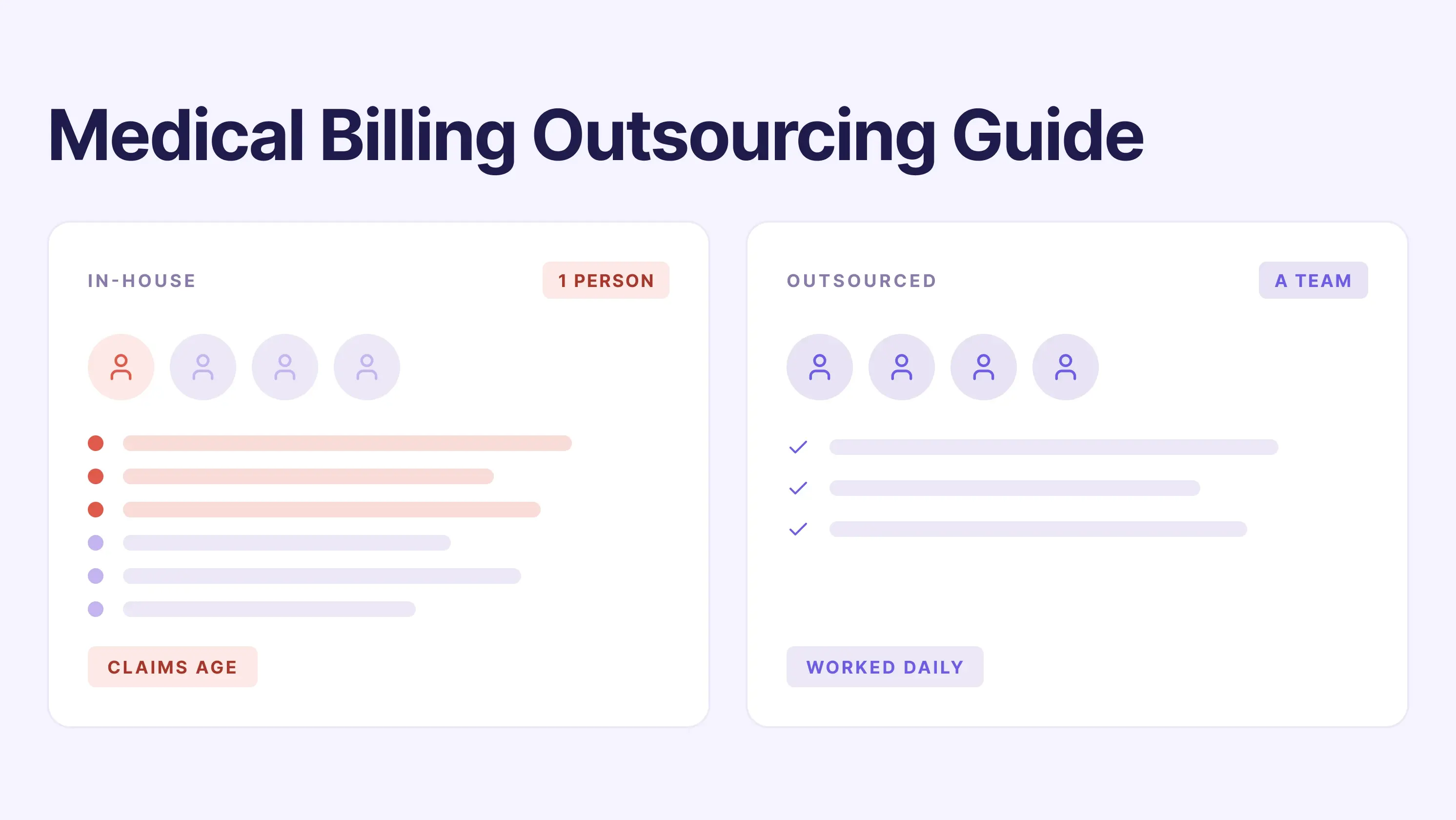
Outsourcing medical billing services means you pay a company to do that list. In-house means you, a spouse, or a hired biller does it, usually inside your EHR. Neither is free. One costs salary and your evenings. The other costs a share of what gets collected.
Here's the comparison that matters in the first 90 days. Fill in the in-house column yourself. A national average won't be your wage.
| In-house | Outsourced | |
|---|---|---|
| Staff | You hire, train, and cover sick days. A solo practice often has one person. When they quit, billing stops. | A team already does the work. You don't manage their time off. |
| Software | You pay for an EHR and, sometimes, a separate billing tool and a clearinghouse login. | Ask whether the EHR is included, or whether you still pay for software on the side. |
| Denials | Someone on your staff works them every day, or they age out and become write-offs. | The contract should say who works denials, how fast, and what you can see. |
| Credentialing | Easy to forget until a payer rejects every claim from a new practice. | Ask whether it's included, and for how many payers. |
| Cash in the first 90 days | Claims go out only as fast as one person can learn your payers. | You depend on their backlog, but you aren't learning payer rules at midnight. |
| Your time | If there's no biller, this is you, after clinic. | You still have to close your notes. You shouldn't have to work the claim queue. |
A worksheet you can do this week, with your own figures:
- How many patient visits do you expect in a typical week once you're open?
- Who, by name, sends the claims if you keep billing in-house? If the answer is you, write down how many hours a week you can give it after the last patient.
- What would you pay that person, or yourself, for those hours? Use a wage you'd offer, not a number from a blog.
- Which software bills do you pay now, or expect to pay, for the EHR, the clearinghouse, and any billing tool?
- If claims sat unpaid for 60 days, could the practice cover rent? A billing company doesn't remove that risk, but someone other than you would be watching the pile.
MGMA reported that 48% of medical group leaders named denials and appeals as their practice's largest source of revenue leakage, against 23% who named front-end issues, in a January 2026 poll. The same piece puts first-submission denials at 7% to 8% across the prior four years.
How Billing Companies Charge: Percentage vs Flat Fee
Medical billing service rates come in two shapes. A medical billing percentage of collections means the company is paid from money it actually brings in. A flat fee means you pay the same amount every month, whether the month was busy or quiet.
Owners ask us whether the rate is fixed. A percentage isn't. It moves when your collections move. A flat fee doesn't, which sounds calmer until a slow month still costs the same.
Pin down three things the sales call tends to skip:
- Percentage of what. Collections, charges, and net collections are different bases. Ask which one, and ask them to say it in a sentence you could repeat to your accountant.
- What sits outside it. Patient payments and cash-pay visits are sometimes excluded. Get that in writing before you compare two quotes.
- What you still pay on top. A smaller percentage plus a separate EHR bill, a clearinghouse bill, and a credentialing bill can cost more than a larger percentage that includes them.
PracticeEHR does the billing for a small percentage of monthly revenue, with the EHR included at no extra cost. You aren't buying software and a billing company as two contracts. Revenue cycle management, or RCM, is the industry name for that done-for-you billing.
Questions to Ask Outsourced Medical Billing Companies
Ask outsourced medical billing companies these questions before you sign, and write the answers down. The ones that matter most are who works denials, how you see your numbers, and what happens to your data if you leave. A friendly demo is not a contract, so get those answers in writing.
- Who works a denial, and how fast? "We have a team" isn't an answer. Ask how quickly they respond to a denial, and whether they go back to older, underpaid claims or only touch what's new.
- How often do you see your numbers? A monthly PDF is how practices discover, late, that AR slipped. Ask whether your clean-claim rate, days in AR, and collections are visible while the work is happening.
- What has to be finished before a claim can go out? If the note isn't done, the claim usually can't go. Ask whether the note and the claim live in one record, or whether someone copies the visit into a second tool.
- Who checks a claim before the payer sees it? A person should still look at it. Software that flags a problem is useful. Software that sends the claim with nobody looking is how denials pile up.
- What happens to your data if you leave? Get the file format and the timeline in the contract.
- Is credentialing included, and for how many payers? New practices lose months here. Credentialing is how you get onto a payer's panel. You can't bill that payer until it's done.
Explore More: Advantages of Integrating EHR with Medical Billing
What Small-Practice Owners Ask Us During Demos
These four questions come up again and again in our demos with small practices.
The first is about what they're buying. Someone will stop a demo and ask, "You mean, like, use your billing software and your billing team? Or what is the other option?" Both exist. Software plus your own biller is one purchase. A team that runs the claims is another, and a vendor who blurs them will sell you the wrong one.
The second is about logins. Owners ask whether the note has to be finished before billing can start, and "Will we ever have to log in to another portal? Is everything in one?" If notes sit in one system and claims sit in another, a person is copying between them. One platform means the schedule, the note, and the claim share a record. Ask it that way.
The third is whether the billing is thorough. Owners who have been burned describe a biller who entered the data and then dropped the denied claims. "How thorough is your billing?" deserves a boring answer: how often claims go out, and how fast a denial gets a response.
The fourth sounds different, and it comes from practices that already switched once. "The last time we moved from one EHR to the new one, we lost a lot of data." A brand-new practice can skip this.
If you're leaving a biller or an old EHR, ask which records come with you (patients, claim history, open AR) and what the old company will export. We wrote separately about switching billing providers without leaving money on the table. Read it before you pick a go-live date. Don't cancel the old biller until someone owns the unpaid claims.
If you already have a biller and the problem is slow posting or undercoding, your real question is the third one. Will the next company work harder on denials than the last one, and can you see it?
Where This Leaves a New Practice
You don't need a billing department to open. You do need a named person, or a named company, who will send the claims, work the denials, and tell you when something is stuck.
PracticeEHR is that one platform. The team submits claims, posts payments, and works denials. You can watch clean-claim rate, days in AR, and collections while that's happening, instead of waiting on a monthly report. Our RCM also covers credentialing and insurance negotiation, so getting onto your first panels isn't a separate project you have to manage.
AI Claim Editor checks a claim and flags warnings and errors before it goes out. A person on the billing team still works the claim.
The scope of what the team takes on is on our page for medical billing services for small practices. Plans are on the pricing page.
One published result: How Magnolia Family Urgent Care Recovered $150K+ in AR and Began Rebuilding Its Claims Success. Magnolia is an established clinic, not a practice on opening day, so this isn't a forecast for your first 90 days.
If you're opening in the next few months and you want to see how notes and billing sit together, you can request a free demo and bring the worksheet with you.
FAQs

.svg)
