

Key Takeaways
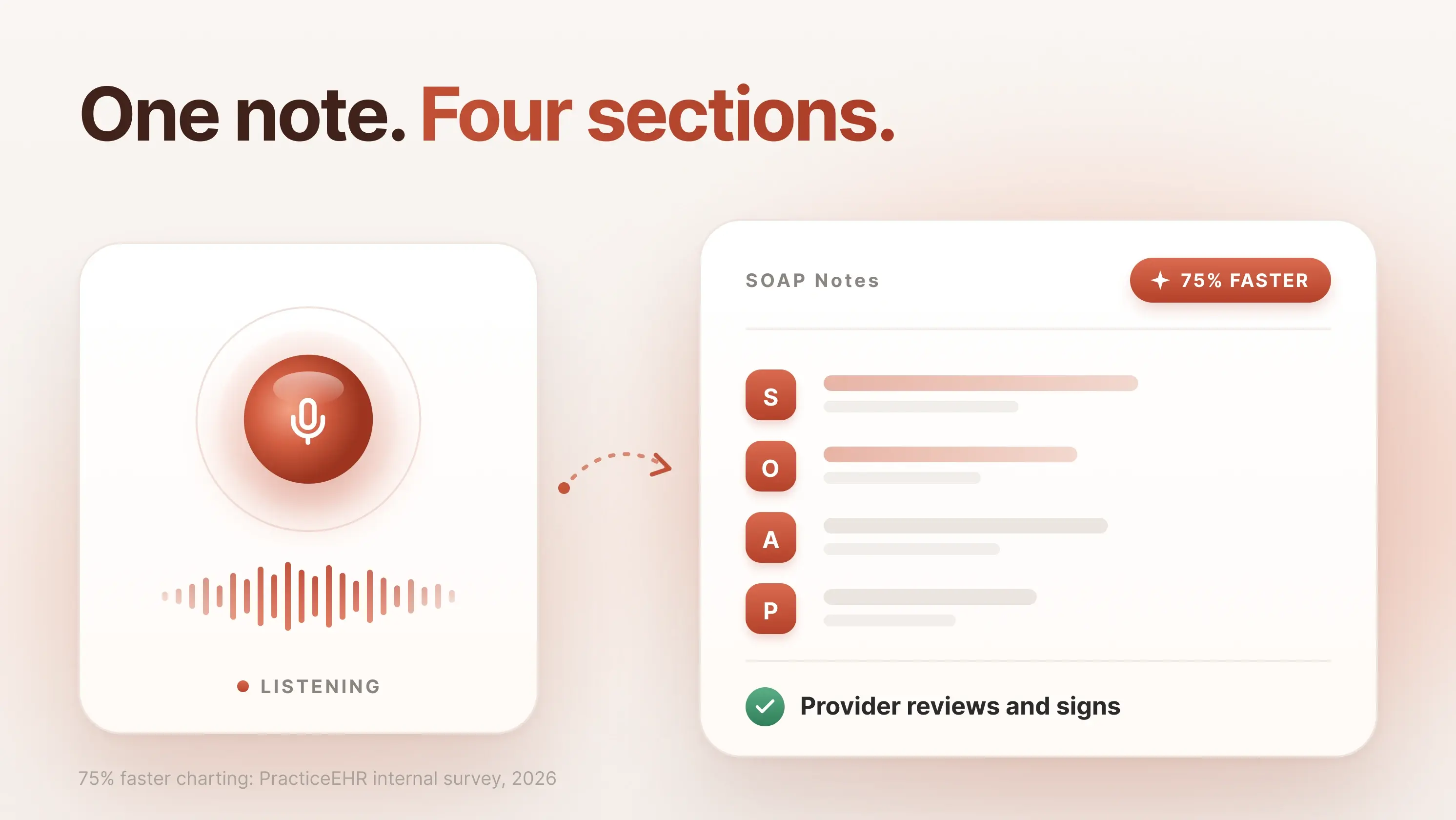
- SOAP Notes divide clinical documentation into four sections: Subjective, Objective, Assessment, and Plan.
- Clear and concise information helps doctors improve care and reduce documentation errors.
- Features like specialty-specific templates and AI ambient scribes streamline charting and reduce repetitive work.
Clinical documentation eats up more of your day as a provider than most patients realize. Studies from the American Medical Association (AMA) put it at roughly two hours of charting per hour of patient care. SOAP notes are a big piece of that workload, and the format itself hasn’t changed much since Dr. Lawrence Weed introduced it in the 1960s.
This guide walks through what SOAP notes are, how to write them well, a full example you can copy, templates for different specialties, and where modern EHR tools fit in.
What are SOAP Notes?
SOAP stands for Subjective, Objective, Assessment, and Plan. It’s a structured format for writing clinical notes so that when you read them, you can understand what the patient reported, what was observed, what the clinician concluded, and what happens next.
Dr. Lawrence Weed developed the format at the University of Vermont as part of the Problem-Oriented Medical Record. The idea was simple; if every provider documented consistently, continuity of care would improve. Sixty years later, SOAP is still the default in most medical, nursing, mental health, physical therapy, and veterinary settings in the United States.
What Are the Four Sections of a SOAP Note?
The four sections in a SOAP note are Subjective, Objective, Assessment, and Plan. Each section has a different use.
-
Subjective
This is what the patient tells you. In their words.
- Chief complaint (why they’re here)
- History of present illness (HPI)
- Review of systems (ROS)
- Past medical, surgical, family, and social history (when relevant)
- Medications and allergies
The subjective section is where you capture context. A patient saying “the pain is a 7, worse when I bend forward, better when I lie flat” tells you more than “patient reports back pain.”
-
Objective
This is what you can measure or observe.
- Vital signs
- Physical exam findings
- Lab results, imaging, diagnostic tests
- Mental status observations (for behavioral health)
Keep opinions out of this section. “Patient appears anxious” is a subjective observation. “Heart rate 112, respirations 22, pacing in exam room” is objective.
-
Assessment
Your clinical judgment. What’s going on with the patient?
- Primary diagnosis
- Differential diagnoses (if the picture isn’t clear)
- Clinical reasoning that connects the subjective and objective data to the diagnosis
- Changes in status since the last visit (for follow-ups)
For complex cases, number the problems. “1. Uncontrolled type 2 diabetes. 2. Diabetic peripheral neuropathy. 3. Hyperlipidemia.”
-
Plan
What you’re going to do about it.
- Medications prescribed, continued, or changed.
- Labs or imaging ordered.
- Referrals
- Patient education provided
- Follow-up timing
- Any procedures performed or scheduled
If you have a numbered problem list in the assessment, mirror that numbering in the plan so nothing gets missed.
How to Write SOAP Notes
Writing a SOAP note becomes easier when you follow a consistent structure. Here are a few steps that you can follow to get structured SOAP notes at the end of the visit.
- Start before the patient leaves the room: Type while the encounter is fresh. It produces better notes than reconstructing six hours later.
- Use the patient’s own words in the subjective section: Quote the patient while they tell you about the problem because quotations are stronger than paraphrases when documenting pain, mood, or chief complaint.
- Separate observation from interpretation: If you’re writing it in the objective section, it has to be measurable.
- Tie the assessment to the data: If you diagnose pneumonia, the subjective and objective sections should present the symptoms and findings that support the diagnosis.
- Make the plan actionable: Specific doses, specific follow-up intervals, specific referrals. “Monitor” is not a plan.
- Avoid copy-paste: It’s the biggest source of chart errors. If you’re using a template, read every pre-filled line before you sign the note.
- Keep it concise: A good SOAP note is thorough, not long. 200–400 words is a reasonable target for most visits.
-
Review for completeness: Before you sign, check that every problem in the assessment has a matching plan.
How AI and EHR Software Are Changing SOAP Notes
Two things are reshaping how notes get written in 2026.
The first is ambient AI scribes. Tools that listen to the visit, transcribe it, and auto-populate a draft SOAP note. The provider only reviews, edits, and signs. According to PracticeEHR’s internal survey, doctors can now chart 75% faster with AI Scribe and boost patient time by 56%.
The second is structured EHR templates. Instead of free-text boxes, modern EHRs offer customizable SOAP note templates by specialty, with dropdowns for common findings, auto-population from vitals and labs, and quick-insert phrases for frequently used instructions.
PracticeEHR’s charting module provides providers with specialty-specific templates, voice-to-text dictation, and one-click copy-forward (with safeguards to prevent the transfer of unresolved problems).
It also auto-pulls vitals, medications, and recent labs into the objective section so you’re not retyping data that already lives in the chart.
What are the SOAP Notes by Specialty?
The four sections stay the same. What goes inside each one shifts depending on the setting.
Primary Care
The SOAP note for primary care has a standard structure. There is a heavier emphasis on chronic disease management, preventive care, and medication reconciliation. The assessment usually has multiple numbered problems.
Mental health and counseling
In the subjective section, document what your patient tells you about their mood, sleep, appetite, and any suicidal or homicidal thoughts. In the objective section, record what you observe, including their effect, speech, thought process, and mental status.
For the assessment, use DSM-5-TR criteria to support your diagnosis and document the patient's risk level. In the plan, outline your next steps, whether that means continuing therapy, adjusting medication, creating a safety plan, or scheduling the next session.
Physical therapy
When writing a physical therapy SOAP note, start by documenting your patient’s pain level, movement difficulties, and functional goals in the subjective section. In the objective section, record measurable findings such as range of motion (ROM), muscle strength, special test results, and gait.
Use your assessment to connect these findings to the patient’s functional limitations and identify areas that need improvement.
Nursing
Nursing SOAP notes focus on patient response to interventions, pain management, intake and output, and nursing diagnoses rather than medical ones. The plan reflects the nursing care plan rather than medical orders.
Veterinary
Same four sections. Subjective comes from the owner. Objective includes species-specific vitals and exam findings. Assessment and plan work the same as in human medicine.
Make Every SOAP Note Count
When you write SOAP notes, you’re doing more than documenting a patient visit. You’re creating a clear record that helps you track progress and make informed decisions till the next visit. But with a busy schedule, keeping every note accurate and complete without spending hours charting can be a challenge.
PracticeEHR helps you spend less time documenting and more time caring for patients. With specialty-specific SOAP note templates, AI Scribe, voice-to-text dictation, and automatic population of relevant patient data, you can create structured notes without starting from scratch every time.
Ready to simplify clinical documentation in your practice? Book a free demo of PracticeEHR and see how the right EHR tools can make every patient encounter easier to document.
Explore more: How AI improves clinical documentation in 2026?
FAQs


