

Key Takeaways
- QHINs connect healthcare organizations nationwide, making patient records easier to exchange across different EHR systems.
- Through TEFCA, providers can securely access patient histories, reduce data silos, and make more informed care decisions.
- PracticeEHR connects practices to nationwide health information exchange through Kno2, with no additional setup required.
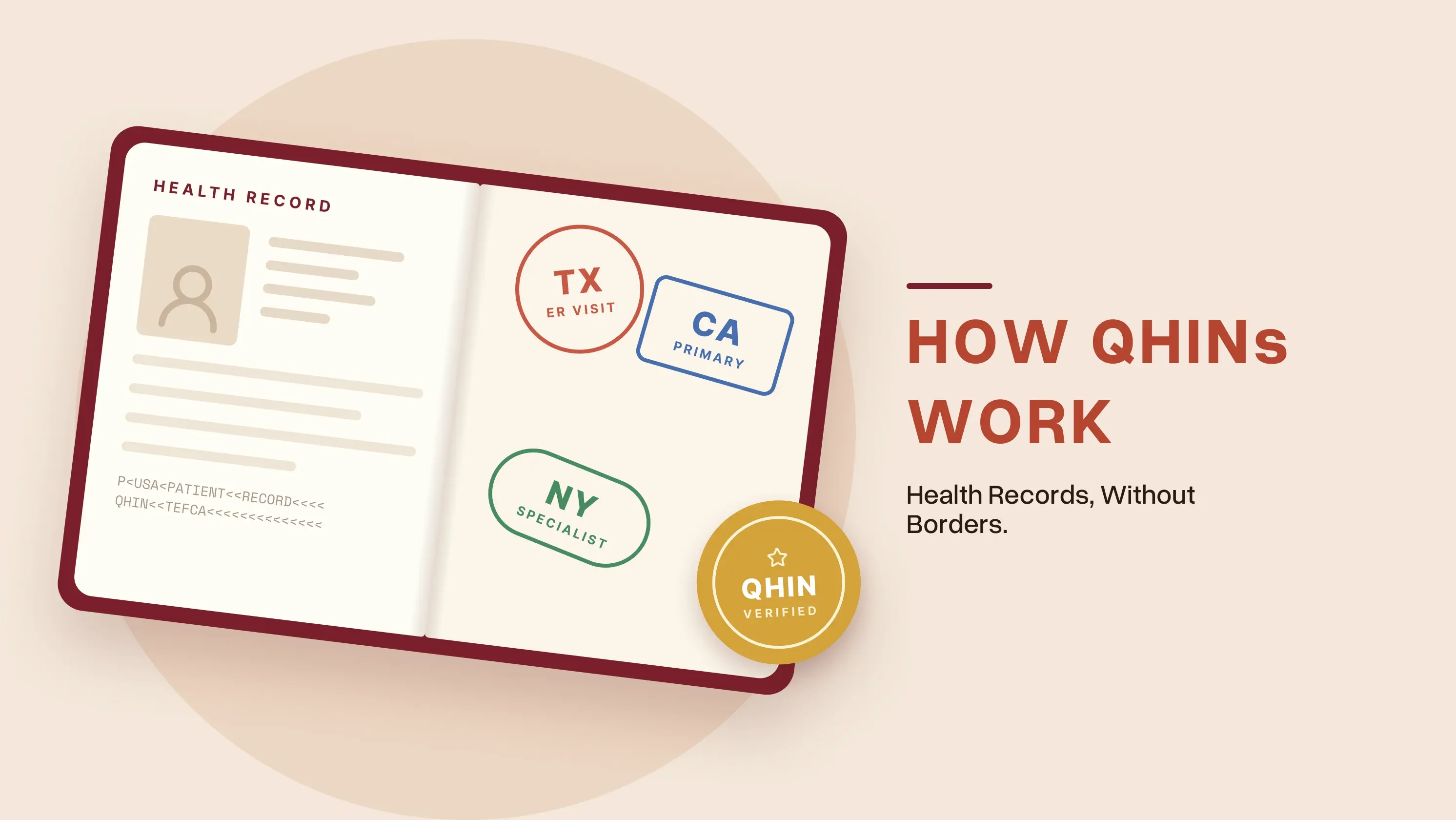
A patient walks into an emergency room in Texas. Her primary care doctor is in California. Her last specialist visit was in New York. Three states, three EHRs, three separate record trails. The ER team has minutes to make a decision, but the full picture of her health is scattered across the country.
This is the reality of fragmented health records. It costs lives, time, and money. That’s exactly where QHIN, or Qualified Health Information Network, plays the part. It is the layer that finally ties together the fragmented pieces of patient care.
In this blog, we will break down what QHINs are, how they work under TEFCA, and why they are changing the game for both patients and providers.
What is a QHIN?
A QHIN is a federally designated network that acts as a nationwide bridge for sharing patient health information. Think of it as an “on-ramp” to a national highway for health data. Hospitals, clinics, labs, payers, and public health agencies plug into a QHIN, and through that one connection, they can send and receive patient records with every other organization on the network.
QHINs are not random vendors. They go through a strict designation process overseen by the Office of the National Coordinator for Health IT (ONC) and managed by The Sequoia Project, which serves as the Recognized Coordinating Entity (RCE).
As of today, there are11 officially designated QHINs recognized by the Trusted Exchange Framework and Common Agreement (TEFCA), including:
- eHealth Exchange
- CommonWell Health Alliance
- Surescripts Health Information Networks
- Epic Nexus
- eClinicalWorks
- Health Gorilla
- Kno2
- KONZA
- MedAllies
- Netsmart
- Oracle Health
More networks are being added as they complete the application and testing process. The list grows on a rolling basis.
How to Join a QHIN?
Joining a QHIN is simpler than most providers think. You do not need to apply to TEFCA yourself or build any technical infrastructure. There are two paths:
Path 1: Through your EHR vendor (recommended for most practices)
If your EHR is already connected to a QHIN, you are one step away from nationwide exchange. The vendor handles the technical setup, legal agreements, and ongoing compliance. You simply sign the Subparticipant terms and start sharing data from inside your chart.
Path 2: Direct Participant onboarding
Large health systems, HIEs, and payers can apply to connect directly to a QHIN as a Participant. This path requires technical resources, legal review, and operational readiness.
For most small to mid-size practices, going through the EHR vendor is faster, cheaper, and easier. For example, PracticeEHR users are already TEFCA-connected through Kno2 (a designated QHIN), with no extra setup needed.
The TEFCA Framework: The Foundation Behind QHINs
QHINs do not exist on their own. They operate under a national framework called TEFCA, or the Trusted Exchange Framework and Common Agreement.
TEFCA was created under the 21st Century Cures Act, passed by Congress in 2016. The goal was simple: fix the broken state of health data sharing in the United States. Before TEFCA, most data sharing happened through one-off, point-to-point connections. Each hospital, each EHR, and each regional HIE built its own pipes. The result was a patchwork of networks that did not talk to each other.
TEFCA set the rules for a single, trusted, nationwide system. It defines who can share data, how they can share it, and what they can use it for.
Inside TEFCA, the structure follows three tiers:
- QHINs sit at the top. They are the nationwide networks.
- Participants connect to a QHIN. These are usually EHR vendors, HIEs, and large health systems.
- Subparticipants connect through a Participant. These are typically individual provider practices.
This three-tier model means that a small clinic does not need to apply directly to TEFCA. It can plug in through its EHR vendor and gain nationwide reach instantly.
How QHINs Are Transforming Health Record Sharing
QHINs are not just another compliance checkbox. They are reshaping how patient data moves across the country. Here is how.
-
From point-to-point to nationwide exchange
Before QHINs, every healthcare organization had to build its own connections. A hospital in Florida wanting to share data with a clinic in Oregon had to set up a direct link, sign agreements, and manage the technical work. Multiply that by thousands of organizations, and the system becomes unmanageable.
QHINs replace this mess with a single connection. One link to a QHIN gives an organization access to every other organization on the network. No more one-off deals. No more custom integrations. Just one on-ramp, nationwide reach.
-
Real-time access to patient history
In the old model, pulling a patient’s records from another provider meant phone calls, faxes, mailed CDs, and days of waiting. Clinical decisions were often made with incomplete information.
With QHINs, a provider can query the national network and pull a patient’s history in seconds. Lab results, discharge summaries, medication lists, allergies, and imaging reports all flow in real time. The ER doctor treating that patient from Texas can see her California primary care notes and her New York specialist records right inside her chart.
-
Fewer data silos, better care decisions
Fragmented records lead to duplicate tests, missed diagnoses, and dangerous drug interactions. When providers only see part of the picture, they make partial decisions.
QHINs break down these silos. A complete longitudinal record means better clinical judgment, safer prescribing, and fewer repeated procedures. It also saves money, since duplicate labs and imaging add up fast across the healthcare system.
-
Patient-driven access to their own records
QHINs are not just for providers. One of the six permitted use cases under TEFCA is Individual Access Services (IAS). This gives patients the right to pull their own records directly from the national network and share them with any provider, app, or caregiver they choose.
For the first time, patients can carry their full health history with them. No more chasing down medical records offices or waiting weeks for paperwork.
Explore More: How future trends are shaping medical management software
Nationwide Exchange is Already Here with PracticeEHR
The future of QHIN is not years away. It is live today.
PracticeEHR is already TEFCA-connected through its Kno2 integration. Kno2 is a federally designated QHIN. That means every practice using PracticeEHR can now exchange patient records safely nationwide, across TEFCA, Carequality, CommonWell, and eHealth Exchange, all through a single connection within the patient chart.
This is especially powerful for multi-location practices:
- Pull a patient’s full history from any clinic location, in any state, in seconds
- Keep records consistent across every site your practice operates
- Cut down on duplicate testing and manual record requests
- Give every provider in your network the same complete view of the patient
One EHR. Nationwide reach. Zero manual record chasing.
See how PracticeEHR connects your practice to the national health data network. Book a free demo today.


