

Key Takeaways
- Modifier 25 applies only to E/M codes when the evaluation is significant and separately identifiable.
- Complete, clearly separated documentation helps demonstrate medical necessity and reduce modifier 25 claim denials.
- Reviewing payer-specific policies and verifying claims before submission can prevent avoidable denials.
Imagine that on a random Monday, a physician like you, running a small practice, is informed about a stack of denial claims from last week. Half of those denials were due to modifier 25. Same remit code on all: “E/M bundled into procedure.” Claims were sent clean, and documentation was complete, but they were still rejected simply because modifier 25 was not separated.
If that situation sounds familiar, you are not alone; the majority of doctors face it due to a lack of knowledge about modifier 25.
Modifier 25 is one of the most-used and most-denied modifiers in physician billing. In fact, multiple insurance companies have also introduced regulations addressing modifier 25. For instance, Cigna now requires documentation support on every modifier 25 claims with minor procedures, with denials for anything less.
This guide covers the rules, the real examples by specialty, the documentation that holds up in an audit, and the appeal workflow when a claim gets denied anyway.
What is Modifier 25?
CPT 2026 defines modifier 25 as an important, separately identifiable evaluation and management (E/M) service. It is by the same physician or another qualified health care professional on the same day and at the same time as the procedure or other service.
In simple terms, you did something beyond the procedure, and that something was a real E/M (Evaluation/Management) encounter with its own history, exam, and medical decision-making.
Two things must be true. The E/M work must be significant. And it must be separately identifiable from the procedure.
Modifier 25 only attaches to E/M codes. That means 99202 through 99215, 99221 through 99239, preventive codes 99381 through 99397, and a few others. You cannot attach it to a procedure code.
When Should You Use Modifier 25? The 3-Question Test
Here’s a small test: before you append modifier 25, run the encounter through three questions.
- Did you perform and document a problem-oriented E/M (chief complaint, HPI, exam, medical decision making)?
- Could that E/M stand on its own as a billable visit if the procedure had not happened?
- Did the E/M go beyond the usual pre-procedure or post-procedure work for that procedure?
If all three answers are yes, use modifier 25. If any of them are not, do not.
When Should You Not Use Modifier 25?
Use the modifier 25 when applicable. Unnecessary use can also lead to claim denial. PracticeEHR’s medical billing team has also noticed a recurring pattern of unnecessary use of modifier 25 by the practices, which they fix before submitting the claims.
One of our medical billing specialists shared her experience with modifier 25 claims. She shares,
“One of the common issues we see is providers adding Modifier 25 without checking whether the documentation supports it. Before appending the modifier, take a moment to review the encounter and confirm that the E/M service was significant, separately identifiable, and properly documented.”
Our billing team also shared a checklist with us, so you can skip modifier 25 when any of the following is true.
- The visit was scheduled only for the procedure, and nothing new came up.
- The work you did was routine pre-op or post-op care already bundled into the procedure.
- A different provider performed the procedure.
- The service you want to attach it to is not an E/M code.
- The procedure has no global period.
- The only “E/M” was the decision to do a minor procedure. That decision is already part of the procedure payment.
The last one trips people up. Deciding to remove a skin tag is not separately billable as an E/M. The procedure code pays for that decision.
Modifier 25 Payer Policies
Insurance companies apply different reimbursement policies and claim edits to modifier 25. While Medicare follows the National Correct Coding Initiative (NCCI) guidelines, commercial payers may have additional requirements. The table below summarizes key considerations, but providers should verify the current policy for their specific plan.
| Payer | Policy | Reimbursement Impact |
|---|---|---|
| Medicare / CMS | Full pay per NCCI edits | None |
| Cigna | Reduced E/M policy for same-day procedure | Up to 50% cut on the second code; appeal common |
| UnitedHealthcare | Follows NCCI | Full documentation audits increased in 2025 |
| Aetna | Follows NCCI | Full |
| BCBS | Varies by state plan | Varies; check local medical policy |
| Humana | Follows NCCI | Full |
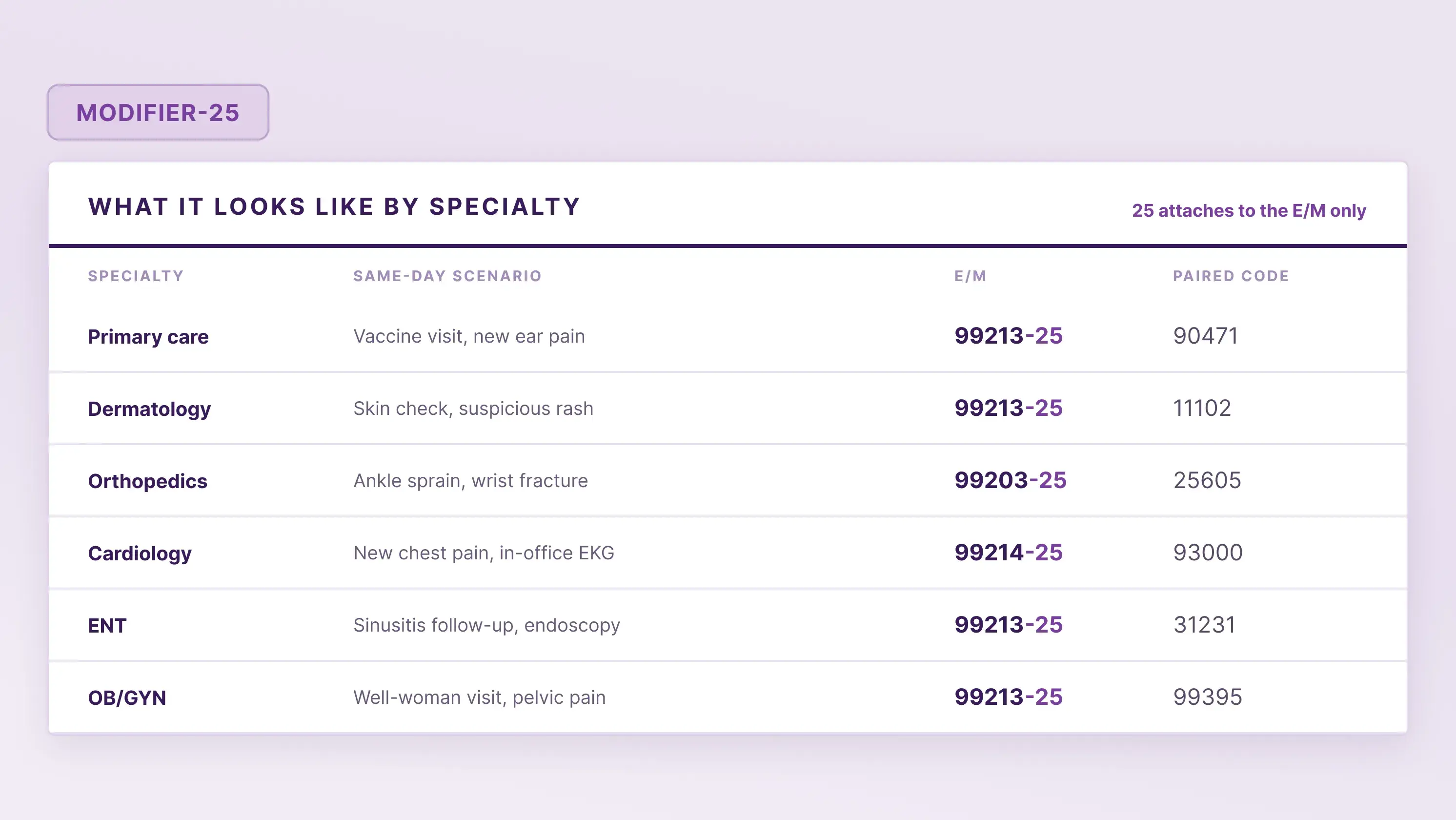
Modifier 25 Examples: 7 Real Billing Scenarios by Specialty
Generic rules only get you so far. Here are the scenarios that most often arise across different specialties.
-
Primary care
A patient visits the clinic for a vaccination and reports ear pain that began a week ago. You examine and review the symptoms to check whether an ear infection is present. You will bill 99213-25 (modifier 25) for a separately billable E/M service plus the vaccine administration code and the vaccine itself.
-
Dermatology
A patient schedules a visit for a routine full-body skin check. During the check-up, you also find a suspicious rash on the leg. You discuss this with your patient and perform a biopsy. The skin check and the conversation about the rash are the E/M. The biopsy is the procedure that will be billed as 99213-25 with 11102.
-
Orthopedics
A new patient visits your clinic with an ankle sprain. During the exam, you also find a wrist deformity from a fall two days earlier, and you do a closed reduction of the fracture. The ankle evaluation is the E/M (99203-25). The wrist reduction is the procedure (25605).
-
Cardiology
An established patient comes in reporting new chest pain. You take a focused history, do an exam, and order an in-office EKG. The EKG interpretation is part of 93000. The chest pain workup is the E/M—Bill 99214-25 plus 93000.
-
ENT
A patient with chronic sinusitis comes in for a routine follow-up. During the visit, symptoms have worsened, and you perform a nasal endoscopy to evaluate. The follow-up evaluation is the E/M. The endoscopy is 31231. Bill 99213-25 with 31231.
-
OB/GYN
A patient arrives for her annual well-woman visit. She also mentions pelvic pain she’s been experiencing lately. You assess the symptoms and order an ultrasound. If the evaluation is separately identifiable from the preventive service, bill 99395 for the preventive visit and 99213-25 for the problem-oriented E/M service.
-
Urgent care
A patient comes in with a facial laceration and also complains of a sore throat with fever. You do a rapid strep test and prescribe antibiotics. The laceration repair is the procedure. The URI evaluation is the E/M. Bill the repair code with 99213-25.
What Documentation Does Modifier 25 Require?
The medical record has to show two separate stories. Think of it this way: if someone pulled only the E/M portion of your note, would it stand on its own?
Here is what your documentation needs.
- A chief complaint for the E/M that is distinct from the procedure.
- HPI, exam, and MDM for the E/M, documented as its own section or clearly set apart.
- Medical necessity for both services.
- A reason you addressed both on the same day instead of asking the patient to return.
Keep the procedure note separate from the problem-oriented progress note where your EHR allows it. In PracticeEHR, you will be given a separate E/M template alongside the procedure template, rather than merging them into a single free-text block. Auditors do look for structural separation.
Does Modifier 25 Require a Different Diagnosis?
No. A different diagnosis is not required for modifier 25. CPT and CMS both say the E/M and the procedure can share a diagnosis.
In practice, same-diagnosis claims get denied more often. That is a payer behavior problem, not a rules problem. When the diagnosis is the same, your documentation has to work harder to show that the E/M went beyond pre-procedure work.
For instance, a patient comes in with a scalp laceration. You repair it (12001). Before the repair, you perform a focused neuro exam to rule out intracranial injury. The diagnosis is the same (head injury), but the neuro exam is working beyond closing the wound. Charges will be billed as 99213-25 (modifier 25) with 12001.
Top 7 Reasons Modifier 25 Claims Get Denied
If you are worried about recurring denials related to the modifier, you are definitely missing something. Here is what the denials actually look like in the field.
- Under-documented MDM. The E/M note does not show the clinical reasoning that justifies a separate encounter.
- The E/M work was bundled into the procedure. Taking vitals and reviewing the chief complaint before a joint injection does not count as a separate E/M.
- Missing medical necessity for the E/M. The chart does not explain why the problem needed to be addressed that day.
- Modifier attached to the wrong code type. Modifier 25 belongs on the E/M code, not the procedure code.
- The procedure has no global period. Modifier 25 applies only to procedures with global days 000 or 010.
- Payer-specific edit. Cigna’s reduction, UHC’s prepayment review, or a local Medicare contractor edit.
- Duplicate claim. A claim was sent twice for the same date of service, without the modifier on the second.
Across our 2026 denial data from PracticeEHR practices, under-documented claims alone accounted for roughly 40% of modifier 25 denials. Documentation is where the money is.
How to Appeal a Modifier 25 Denial?
Most denials are appealable, and most appeals win when you include the right evidence. Here’s the workflow you need to understand to appeal modifier 25:
- Pull the EOB and read the exact denial reason code under the remit code section. Do not guess.
- Pull the full chart note for the date of service. Confirm that the E/M documentation is complete.
- Write a cover letter that states the modifier 25 criteria and explains how your documentation meets them. Reference the specific CPT guideline and, for Medicare, CMS IOM Pub. 100-04 Chapter 12 Section 30.6.6.
- Attach the full E/M note and the procedure note. Highlight the sections that show the significant separate work.
- Submit through the payer’s standard appeal channel. Track the submission date. Medicare’s redetermination deadline is 120 days from the EOB date. Most commercial payers give 90 to 180 days.
A denial letter template that works across most payers is included in our free Modifier 25 Appeal Kit (PDF download at the bottom of this page).
Modifier 25 vs Modifiers 24, 27, 57, and 59
Mixing up the codes is one of the primary reasons for claim denials. Billers often confuse modifier 25 with modifier 57. Use 57 when the E/M led to a major surgery (90-day global). Use 25 for a minor procedure (000 or 010 global).
The table below shows the common modifiers with their use cases.
| Modifier | Use Case | Attaches To |
|---|---|---|
| 25 | Significant separate E/M on procedure day | E/M only |
| 24 | Unrelated E/M in post-op global period | E/M only |
| 27 | Multiple outpatient E/M encounters on the same day | E/M only |
| 57 | Decision for major surgery | E/M only |
| 59 | Distinct procedural service | Procedure codes |
Reduce Modifier 25 Denials Before Claims Go Out
Modifier 25 can be easy to misuse, and even a small documentation gap can lead to claim denials and unnecessary appeals. The key is to verify that the E/M service is significant, separately identifiable, and supported by the medical record before submitting the claim.
PracticeEHR helps practices address these challenges by providing a dedicated medical billing team. Our billing experts review claims, identify potential issues, and reduce avoidable billing errors before submission. Instead of spending hours correcting denials, your team can focus more on patient care.
Want to spend less time managing billing issues? Explore PracticeEHR’s medical billing and revenue cycle management services and see how the right billing support can help your practice streamline claims and collections.
Explore more: How PracticeEHR Helps Practices Track Their Billing Company’s Performance.
FAQs

.svg)
