

Key Takeaways
- In most cases, insurance credentialing stays with the group, not with you. You have to reapply under your own Tax ID with almost every payer.
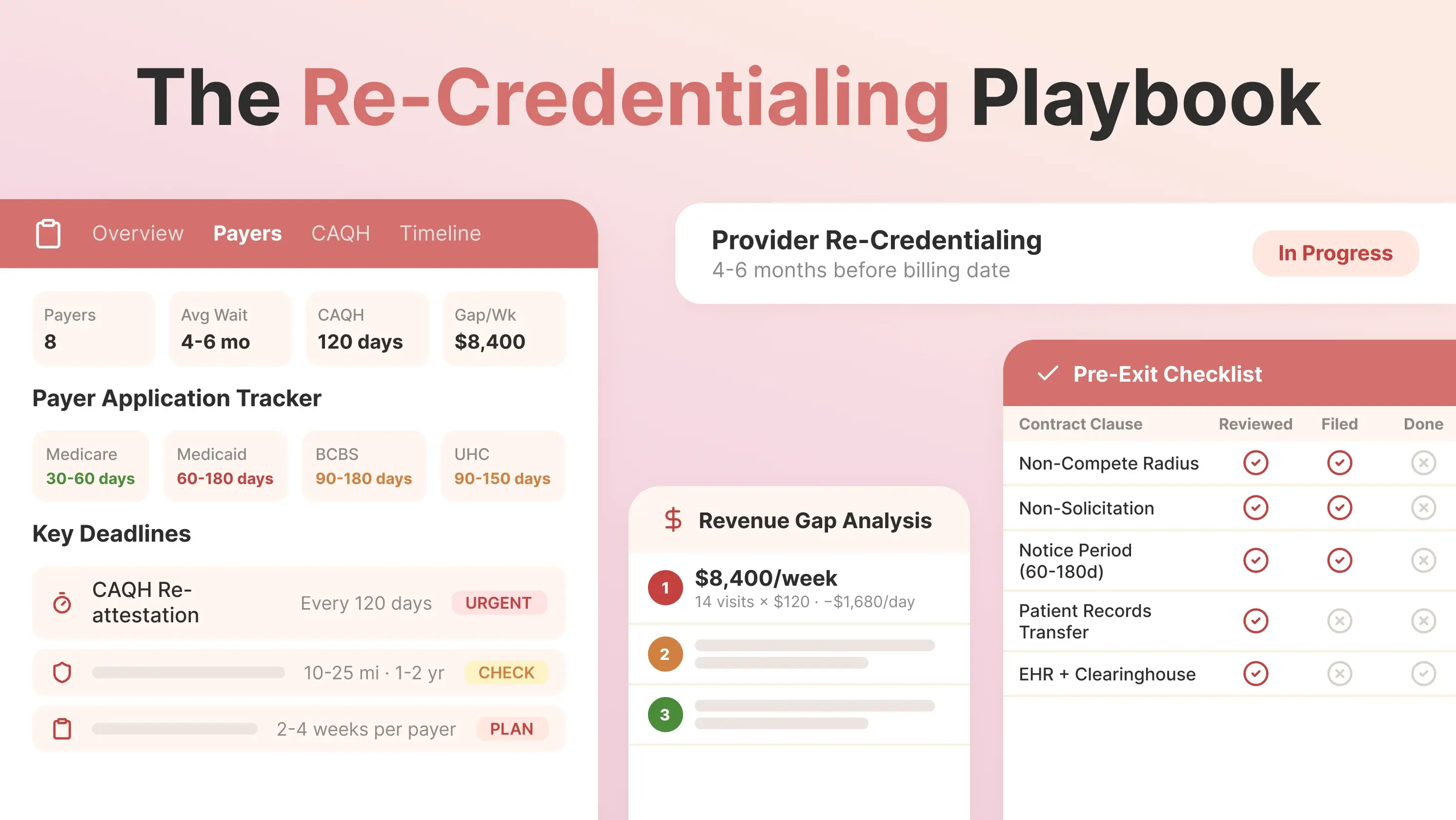
- Plan for 4 to 6 months of runway before your target billing date. Some payers can run up to 6 months on their own.
- Your non-compete clause and your credentialing timeline are directly connected. If your new location falls inside the restricted radius, you cannot list it on payer applications.
- You can usually start payer applications while still employed at the group, which is often the difference between a smooth launch and 3 months of lost revenue.
You put in your notice, signed a new lease, and picked out furniture for your solo office. Then someone asks: "What about your insurance panels?"
This is the part most providers do not want to hear. In most cases, your insurance credentialing does not walk out the door with you. The panels you spent years building at the group practice belong to the group, not to you. To bill under your own name, you have to start over with almost every payer.
That does not mean you are stuck. However, it does mean you need a solid plan. And you need it well before your last day!
The One Credentialing Question That Decides Everything
Before you do anything else, find out how you were credentialed at the group. This single detail changes the entire timeline.
There are four common scenarios:
Scenario 1: You were credentialed under the group contract (most common)
The group holds the payer contract under its Tax ID. You rendered services under that contract. When you leave, that contract stays with the group. You will need to submit fresh applications to every payer under your own Tax ID.
Scenario 2: You were individually contracted while working in the group
Less common, but it happens. In this case, you may only need to update your billing address, practice name, and Tax ID with each payer, rather than applying from scratch. Confirm this in writing with each payer before you assume anything.
Scenario 3: You are enrolled in Medicare through the group only
Your Medicare billing privileges are tied to the group's CMS-855B through a CMS-855R reassignment. You keep your individual PECOS enrollment, but must submit a new CMS-855R to reassign your benefits to your new practice.
Scenario 4: You have a hybrid setup
Some payers credentialed you individually, others through the group. This is the trickiest situation because you have to sort each payer separately.
Call each payer directly and ask: "Under what contract was I credentialed at [group name], and what do I need to do to bill under my own Tax ID?" Get the answer in writing if you can, because reps sometimes give conflicting information.
What Each Major Payer Actually Requires
Timelines vary by state, network need, and how clean your application is, but these numbers give you something real to work with.
Two things to keep in mind. First, "credentialing complete" and "you can bill" are not the same thing. Contracting, network loading, and directory updates all happen after credentialing approval, and each adds days or weeks. Second, most of these payers will not begin your application until CAQH is current and fully attested, which brings us to the next problem.
The CAQH Trap Nobody Warns You About
CAQH (or DataSpring, according to the new rebrand) is the shared database that most commercial payers use for credentialing. If your CAQH profile was set up and managed by the group's credentialing staff, you may not have current login credentials. Even if you do, the profile will probably list the group as your practice location, use the group's contact information, and show the group's Tax ID.
That profile has to be updated with your new practice information before you submit any applications. Also, CAQH requires re-attestation every 120 days. Miss it, and your profile shows as "expired" to payers, which freezes your applications.
So, do this before you leave:
- Log in to the CAQH Provider Data Portal (formerly ProView) and confirm you can access your own profile.
- Note the last attestation date.
- Do not update your practice information yet. Wait until you have your new Tax ID and business address ready, because payers will pull your data at the moment you submit each application.
- Once your new information is stable, update everything at once and re-attest.
The Revenue Math on a Credentialing Gap
Credentialing delay is costly. Let’s do the math.
Say you see 20 patients a day, the average reimbursement is $120 per visit, and 70% of your patients use insurance that you have to re-credential for. That is 14 insured visits a day, or $1,680 in daily revenue tied to panels. For every week you are out-of-network, you lose roughly $8,400 in billable revenue.
You have three options during the gap:
- See patients who pay cash at a reduced rate. This preserves the relationship but not the revenue.
- Ask payers for a retroactive effective date. More on this in the following section.
- Delay your launch until your top three or four payers approve. This is the safest option if insurance revenue is essential to your business.
The Retroactive Effective Date Nobody Talks About
Some payers will backdate your effective date to the date you started seeing patients at the new practice, but only if you ask and meet their conditions. Medicare, for example, has a limited 30-day retrospective billing rule under 42 CFR 424.521. Commercial payers vary, and it is entirely at their discretion.
You have to request this in writing during the application, not after approval. Include the date you started at the new practice and the reason for the gap. Some payers grant it. Many will not. But you will never get it if you do not ask.
What Your Non-Compete Has to Do With Credentialing
Your non-compete clause and your credentialing timeline are directly linked, and if you miss the connection, you can either violate your contract or waste months of runway.
Most physician non-competes restrict you geographically for a set period (commonly 10 to 25 miles for 1 to 2 years). If your new practice location falls inside that radius, you cannot legally open there, even after you resign. So, before you file any credentialing paperwork listing that address, confirm your new location complies with the non-compete.
Also, in most states, you can start payer applications while you are still employed at the group. As one specialist put it, the purpose is not to hide a transition, but to avoid quitting first and discovering that independent payer participation may take months. Just make sure your employment agreement does not prohibit this. Some contracts include language against "preparing to compete" while employed. Read the fine print before you file.
The FTC's 2024 rule that would have banned most non-competes was struck down in court, and by 2026, the FTC had dropped its appeals and removed the rule. It is not in effect. Enforceability now comes down entirely to your state's law — some states (California among them) void physician non-competes altogether, while others enforce them. Read your contract and check your state.
The Backward-Planning Timeline
Instead of picking a resignation date and hoping credentialing catches up, work backward from when you need to start billing.
Here is the template:
- Month 0 (target payer effective date): The date you need to be billing insurance.
- Minus 4 to 6 months: Submit applications to all target payers. Confirm CAQH is clean and attested.
- Minus 5 to 7 months: Business setup complete. Your Tax ID (EIN), NPI-2, business bank account, malpractice insurance, and practice address are all in place. Update CAQH with new details.
- Minus 6 to 8 months: Review your employment contract, especially non-compete and non-solicit clauses. Talk to a healthcare attorney if any language is ambiguous.
- Minus 8 to 12 months: Start planning. Decide on entity structure, location, and EHR/practice management system.
If you need to bill insurance by June 1, your business setup should be done by February at the latest, which means you should plan the exit for the previous fall. Compress the timeline only if you plan to launch cash-pay or if you have written confirmation from a payer that a lighter update path applies.
Contract Clauses to Review Before You Leave
Your employment agreement almost certainly contains clauses that affect your exit, and they often surprise providers who assumed the credentialing question was the whole story. Look for these:
- Non-compete radius and duration. Where can you practice, for how long?
- Non-solicitation of patients. Whether you can inform existing patients you are leaving, and how.
- Patient records ownership. Who owns the charts, and what is the process for record transfer?
- Notification requirements. Some contracts require 60, 90, or 180 days' written notice.
- Buyout clauses. Some non-competes can be bought out for a set fee.
- Deferred compensation forfeiture. Leaving before a vesting date can cost you money.
A healthcare attorney can review this in 1 to 2 hours and save you months of trouble. Worth every dollar.
What Happens to Your In-flight Claims
You saw patients at the group last week. Some of those claims have not been billed yet. Who owns them?
The group does. Any service rendered under the group's Tax ID belongs to the group's billing cycle, regardless of when you leave. You do not get to bring those AR balances with you. Make sure your final compensation reconciliation accounts for these correctly. If your contract includes production-based pay, some of your last paycheck will come 30 to 90 days after your last day as those claims process.
Needless to say, patients transitioning with you will need to schedule new appointments with your new practice once your payers activate. Their prior visits stay with the group.
State-specific Medicaid Rules to Check
Medicaid is state-run, so re-credentialing rules vary widely. A few things to watch for, depending on where you practice:
- California (Medi-Cal): Requires PAVE 2.0 enrollment. Timeline runs 90 to 180 days.
- Texas: Requires enrollment through TMHP. Managed care organizations (MCOs) require separate credentialing in addition to state enrollment.
- New York: Medicaid managed care plans each require separate applications after state enrollment.
- Florida: AHCA enrollment, followed by MCO credentialing for each Medicaid managed care plan.
If a large share of your patients are on Medicaid, start the state application first. It is usually the slowest.
Setting up Your EHR and Practice Management System Before Day One
This is where many solo launches stumble. Your credentialing can be approved on paper, but if your EHR is not configured with your correct NPI, Tax ID, taxonomy codes, and payer connections, your first claims will bounce.
Before you see your first patient, your practice management system should have:
- Your individual NPI (NPI-1) and business NPI (NPI-2) both loaded correctly.
- Your new Tax ID is mapped to each payer.
- Payer-specific enrollment for electronic claims (EDI) and electronic remittance advice (ERA). This is separate from credentialing and takes its own 2 to 4 weeks per payer.
- Your fee schedule is configured.
- Clearinghouse connections tested with a few dummy claims.
Providers who wait until after credentialing approval to think about their EHR often lose another 2 to 3 weeks before they can actually send a clean claim. If you are evaluating systems and all of this seems like too much work, you can always call PracticeEHR for help. PracticeEHR is built to handle the exact setup solo providers need in this transition, with payer enrollment support and clearinghouse connections included.
Final Thoughts
Yes, in most cases, you have to re-credential under your own name when leaving a group practice. The exception is if you were individually contracted rather than credentialed under the group. Either way, plan for 4 to 6 months of runway before you need to bill, review your employment contract for non-compete and notice clauses, get CAQH under your control, and set up your EHR before your effective dates take effect.
Give yourself 8 to 12 months. Your credentials are not portable, but your timeline is fully in your control. If you're planning to leave your group, you can get credentialed for free when you sign up with PracticeEHR.

.svg)
