

Key Takeaways
- Most practices switch because of a specific pain point, such as pricing, poor payer connections, weak support, or the single-vendor risk exposed by the 2024 Change Healthcare attack.
- A safe switch runs both clearinghouses in parallel until every payer's EDI, ERA, and EFT enrollments have moved and been confirmed with real 277CA acknowledgments.
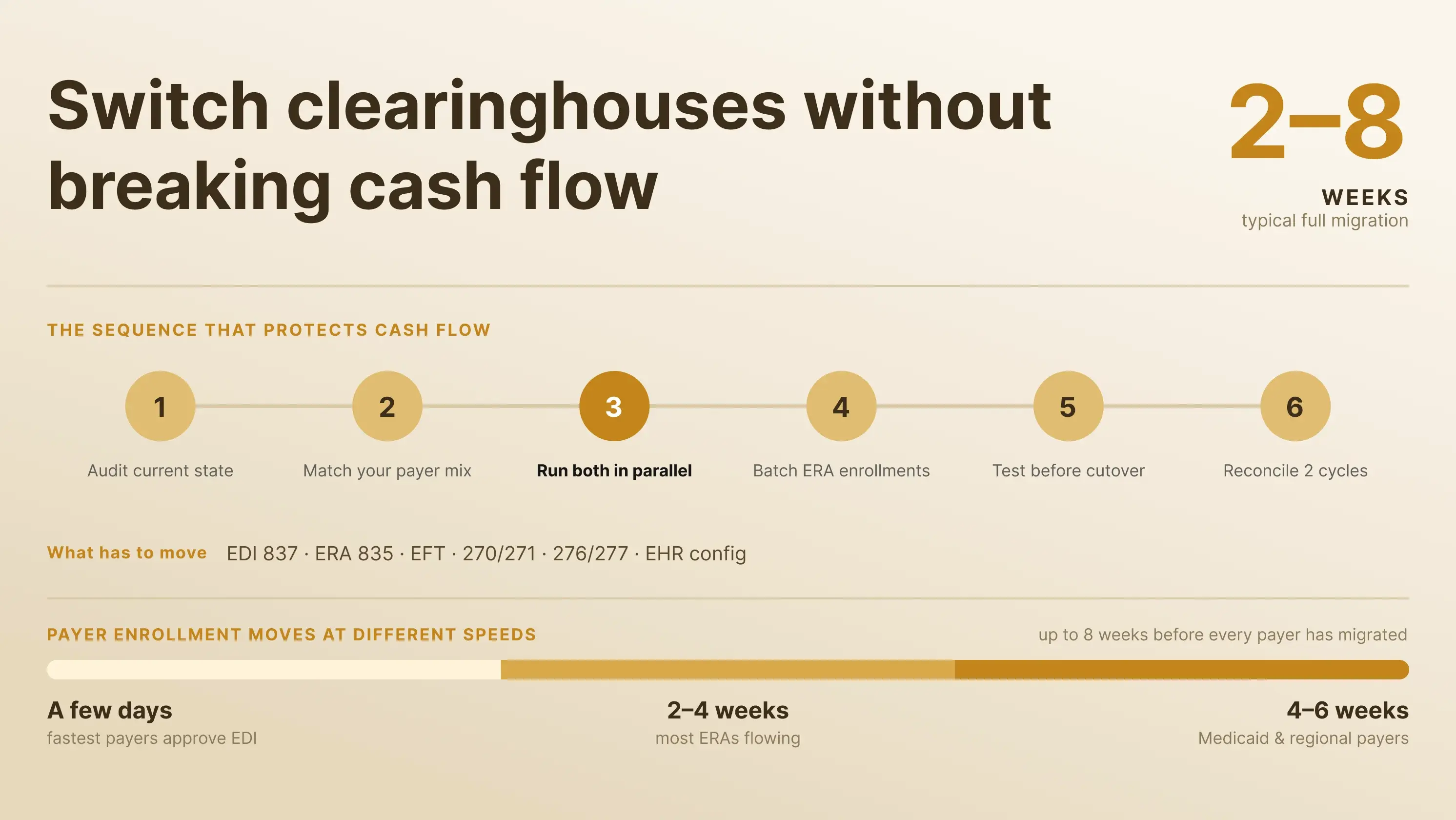
- Full migration timelines typically range from 2 to 8 weeks, depending on how many payers you bill and how quickly ERA enrollments come through.
- Rather than stitching together multiple vendors, switching to a single EHR platform with an integrated clearinghouse is a much safer option.
Two years after the Change Healthcare cyberattack froze claim submission for thousands of practices, the way billing teams think about healthcare clearinghouses has changed. It used to be a background piece of the revenue cycle that nobody touched unless the contract came up for renewal. Now, it's the single point of failure everyone is nervous about.
That anxiety has pushed a lot of practices to start asking hard questions. Is our current clearinghouse actually the best fit? What happens to our cash flow if it goes down tomorrow? And if we do switch, how do we do it without losing two weeks of revenue?
This guide walks through what a clearinghouse switch actually looks like in 2026, the mistakes that cost money, and what to plan for before you sign anything. Let’s begin…
How to Switch Healthcare Clearinghouse: A Step-by-Step Guide
The teams that make it through a clearinghouse migration without a revenue dip tend to follow a similar sequence. Nothing here is rocket science, but skipping any of these steps usually costs money.
-
Audit Your Current State First
Before you pick a new vendor, know exactly what you have. Pull together:
- A list of your top 10 payers by claim volume
- Current clean claim rate and first-pass acceptance rate
- Denial reasons that show up most often
- Existing EDI, ERA, and EFT enrollment records
- Contract terms, renewal date, and any exit clauses
If you can't answer these off the top of your head, that's already useful information. It means your current setup isn't giving you the visibility a practice this size should have.
-
Find A New Clearinghouse Against Your Actual Payer Mix
First, ask any vendor you're evaluating for their real payer list and make sure that your top payers are on it with direct connections. They mustn’t be routed through an intermediary. Also, confirm that responses for 276/277 return usable claim status data.
Ask about phone support hours, since email-only support is a real problem when a batch fails at 4:30 PM on a Friday.
3. Run Both Clearinghouses in Parallel
Do not pull the plug on your old clearinghouse as soon as the new one goes live. You have to keep submitting claims through the old setup while you process a small volume of live claims through the new one. Importantly, watch for 277CA acknowledgments to confirm claims are reaching payers.
Ten business days of overlap is usually the minimum. Two to four weeks is more realistic for practices with a mixed payer book.
4. Submit ERA Enrollments in Batches, Track Everyone
Once ERA enrollment is approved for a payer, that payer's remittances start flowing to the new clearinghouse and stop flowing to the old one. If your posting team isn't tracking which payers have moved, ERAs will land in one system while posters are still looking in the other. Keep a shared tracker with the payer name, enrollment submission date, status, and effective date.
5. Test Before Full Cutover
Can’t emphasize this enough. Run a controlled batch of test claims through the new clearinghouse. Verify that:
- The 837 file passes clearinghouse edits without new rejections
- The 277CA comes back confirming payer acceptance
- The 835 remittance posts correctly to your Practice Management system
- EFT payments match ERAs on the trace number
Any variance here is a lot cheaper to fix at test volume than after you've moved 5,000 claims through it.
6. Reconcile to Catch Errors Early
For the first two billing cycles after full migration, compare your AR trends, denial rates, and days in AR against your baseline from Step 1. While small dips are normal in the first two weeks, any consistent deterioration means something isn't set up right, and it's easier to catch early.
What Happens When You Switch Healthcare Clearinghouses
Most of the difficulty in a clearinghouse migration comes from the fact that every payer treats enrollment slightly differently, and the timelines are outside your control.
Below’s what has to move for a full switch to be complete:
- EDI (837) claims enrollment for each payer that requires a specific submitter ID
- ERA (835) enrollment, so remittances flow to the new clearinghouse instead of the old one
- EFT enrollment if payment routing details need to change, though this is often payer-side and independent
- Eligibility and claim status transactions (270/271 and 276/277)
- EHR or practice management system configuration to point at the new clearinghouse's endpoints
Payer enrollment timelines vary a lot. Some payers approve EDI enrollments in a few days. Others take 4 to 6 weeks, especially Medicaid plans and smaller regional payers. For a mid-sized practice billing 15 to 30 payers, plan on 2-4 weeks before most ERAs are flowing through the new clearinghouse, and up to 8 weeks before every enrollment is fully migrated.
Because these timelines are staggered, you'll have a period when some ERAs come through the new clearinghouse while others still land at the old one. That's normal, but it's also where errors and missed remittances occur if nobody is actively tracking enrollment status for each payer.
Mistakes That Cost Practices the Most Money
A few patterns show up over and over in switches that go badly:
- Cutting off the old clearinghouse too early. Claims sit in limbo while enrollments are still pending.
- Not tracking ERA enrollment per payer. Remittances get lost or posted late, AR ages, and posters spend hours reconciling by hand.
- Skipping test claims. New clearinghouse rejections don't show up until you're at full production volume.
- Choosing based on price alone. The cheapest option with poor support or weak payer connections costs more in denials than it saves in fees.
- Ignoring hidden fees. Setup costs, per-ERA charges, and annual price hikes can double the sticker price by year two.
- Assuming your EHR handles it. If your EHR is gateway-dependent, the "switch" may just be a rerouting within the same infrastructure, which doesn't provide real redundancy.
Reworking a rejected claim costs between $25 and $40 in staff time. A migration that results in 100 extra rejections in the first month is already a $2,500–$4,000 mistake.
What to Look at Before You Sign
Here’s a quick checklist before finalizing a new clearinghouse contract:
-
Direct connections to your top 10 payers
-
276/277 support that returns actionable status
-
Clean claim rate data from current clients in your specialty
-
Phone hours, response times, and a dedicated account rep
-
All fees properly itemized (setup, per-claim, per-ERA)
-
Contract exit clauses and data portability if you switch again
-
FHIR/API readiness for CMS-0057-F (effective 2027)
That last one is worth flagging. CMS-0057-F requires FHIR-based real-time exchange for certain payers by 2027, and CMS-0053-F updates X12 v6020 standards for claims attachments starting May 2026. Medical Clearinghouses that haven't modernized their infrastructure will have a rough transition, and the practices connected to them will feel it too.
Explore more: Tips For A Smooth Transition To A New Clearinghouse
Final Thoughts
The way to think about changing a clearinghouse in 2026 is different from how it was five years ago. It used to be a utility, like electricity. You picked one, forgot about it, and only noticed if something broke. Now, it's closer to a critical vendor relationship that deserves the same scrutiny as your EHR or your billing service.
This is also why more practices are moving toward EHR platforms with built-in healthcare clearinghouses, rather than stitching together separate vendors. PracticeEHR is one option worth looking at on that front.
Claims, ERAs, and eligibility checks run within the same system your billing team already works in, which removes much of the gateway dependency and visibility gaps discussed earlier. You get real-time claim status, itemized denial data, and a support team that can see both the EHR and the clearinghouse side of a problem in one place.
If your current setup is showing any of the warning signs above, slow ERAs, rising denials, weak payer connections, or a renewal quote that keeps climbing, it may be worth a short call with the PracticeEHR team to see what a cleaner setup would look like for your practice.
FAQs

.svg)
