

Key Takeaways
- A cardiology EMR should make everyday charting easier by bringing patient data and test results together in one place.
- The best EMR depends on practice size and workflow needs, from solo cardiologists to large interventional groups.
- Strong billing and reporting tools can improve coding accuracy, reduce claim denials, and support better revenue management.
Practicing cardiology is not just about documenting patient visits and filling the encounter forms. It's about bringing together ECGs, imaging, measurements, medication history, prior studies, and other clinical data in one workflow. Yet a 2024 research published in Studies in HealthTech and Informatics shows that even ECG data can be difficult to integrate into clinical information systems.
This is exactly where cardiology EMRs play the role. They support the way cardiologists capture, review, and connect specialized clinical data. This guide compares the EMRs cardiologists actually use in 2026, shows what to look for when you evaluate one, and points out where the sales demos usually skip the parts that matter.
What Is Cardiology EMR Software?
A cardiology EMR is an electronic medical record system with charting templates, device integrations, and coding libraries built specifically for cardiac care. That's the short version.
The longer version: general EMRs give you a blank SOAP note and a drug database. A cardiology EMR gives you a stress test template that pulls in the treadmill protocol, an echo report that auto-populates measurements from your ultrasound machine, a cath report structured around ACC/AHA reporting standards, and a code library that knows the difference between a 93306 and a 93307 without you having to look it up.
Who actually needs one? Solo cardiologists get the biggest time savings because they don't have scribes to hide the charting friction. Small groups (2-5 cardiologists) need it for consistency across providers. Interventional and EP practices need it because their procedure documentation is where general EMRs fall apart hardest. Nuclear cardiology practices need it for the reporting workflow around stress imaging.
Must-Have Features in a Cardiology EMR
Before you sit through a demo, know what you're looking for. Here's the short list.
-
Cardiology-specific charting templates
The specialty-specific templates matter more than any other feature. Look for pre-built forms for consult H&P, follow-up notes, stress test reports (Bruce, modified Bruce, pharmacologic), echo reports (TTE, TEE, stress echo), cath reports, EP study notes, and device interrogation. If you have to build these yourself, you're paying to be the vendor's product designer.
-
ECG and DICOM image handling
Your EMR should pull ECG waveforms directly from your machine, not require a PDF upload every visit. Same for echo, nuclear, and cath images. DICOM support isn't a bonus feature in 2026; it's table stakes. If the vendor says "we can integrate with that," ask who pays for the interface and how long it takes.
-
Device data integration
Pacemaker, ICD, CRT, loop recorder, and CGM data should land in the chart automatically from Medtronic CareLink, Boston Scientific Latitude, Abbott Merlin.net, and Biotronik Home Monitoring. Manual entry from a printed report is not a workflow. It's a tax.
-
Cardiology-specific ICD-10 and CPT codes
The code library should surface 93000, 93010, 93306, 93307, 93312, 93458, 93460, 93653, and their common modifiers as first-class options, not buried under a general search. Same for the diagnosis codes you use daily: I25.10, I48.91, I50.9, I10, and the rest.
-
E-prescribing with cardiac interaction checks
Warfarin, amiodarone, digoxin, and the DOACs all have interaction profiles that generic drug databases handle poorly. Ask the vendor to walk through what happens when you prescribe amiodarone to a patient already on warfarin. If the alert is generic ("possible interaction"), keep looking.
-
Patient portal for chronic care follow-up
Most of your patients have HFrEF, AFib, HTN, or CAD. They come back every 3-6 months. A good portal lets them upload home BP logs, weight trends, and symptom check-ins between visits, which cuts down on phone triage.
Where a Cardiology EMR Actually Saves You Time
Feature lists don't tell you where the minutes come back. These four workflows below tell how a reliable cardiology EHR can save you time so you can focus on patient care.
1. Pre-visit chart prep: A good EMR auto-pulls the last echo, catch, and stress result into the next visit note before you walk in the room. If you're still opening three tabs to prep a chart, that's 90 seconds per patient times 20 patients a day.
2. Structured data over free text: Free-text notes look fast when you're typing but slow you down for years afterward, because you can't query them. Structured entry for EF, valve function, rhythm, and NYHA class means you can pull a patient list in 10 seconds for any registry or QI project.
3. Referral and consult loop closure: Cardiology lives on referrals. Your EMR should track which referring PCP sent the patient, auto-generate the consult letter, fax or e-send it back, and flag any that haven't closed the loop in 14 days. Missed loops are missed follow-ups and missed revenue.
4. Interventional workflow: For cath lab practices, look at how the EMR handles pre-procedure H&P, consent, timeout documentation, procedure notes with structured findings (vessel, lesion %, intervention, stent type), and post-procedure orders. This is where most general EMRs collapse.
Best Cardiology EMR Software in 2026
Here's how the main options compare for small cardiology practices. Pricing signals are based on public pricing pages and reported user data; get a quote for your specific setup.
PracticeEHR
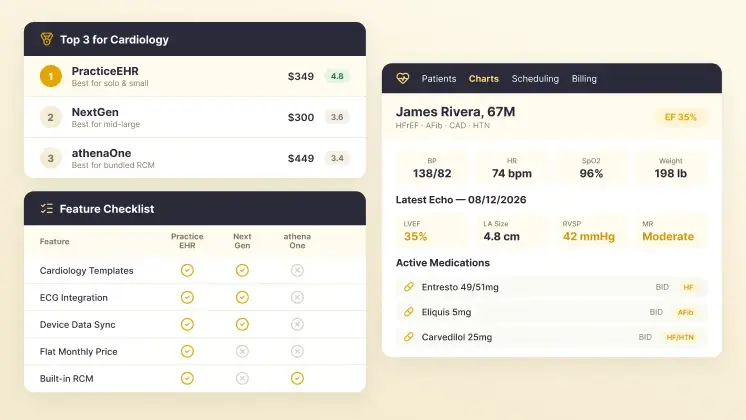
Built for small and independent practices, with cardiology templates included rather than sold as an add-on. Cloud-based, so no server room. Integrated billing and RCM services are available if you want them, which matters for solo cardiologists who don't want to hire a biller.
It would not be the right pick if you're a 50-provider group looking for deep customization at the enterprise level. Best fit: solo cardiologists and groups of 2-10 providers who want to go live in weeks, not quarters.
AdvancedMD
Solid software with cardiology templates available as a specialty add-on. Good scheduling and billing. The cardiology depth depends heavily on how much you customize during setup. Pricing is per-provider per-month plus setup and add-ons; the sticker often surprises small practices. Best fit: small groups already using AdvancedMD in another specialty.
Tebra (Kareo)
Popular with small practices, especially solo. The cardiology-specific content is thinner than dedicated cardiology EMRs. You'll spend time building templates. It is best for solo cardiologists who prioritize marketing and patient acquisition alongside the EMR.
eClinicalWorks
Wide feature set with cardiology modules. The interface has a learning curve, and support experiences vary. A common complaint the user reports is the number of clicks per note. Multi-provider groups with dedicated IT support can go for this software.
NextGen
Strong cardiology templates, especially for interventional. Historically more expensive and heavier to implement. Best fit is mid-to-large cardiology groups doing high procedure volume.
athenaOne
Cloud-native with strong revenue cycle features. Cardiology depth is partial; you'll want to check specific templates against your workflow. Pricing is a percentage of collections, which scales with you but stings during high-collection years. Best fit: mid-size groups that want billing bundled tightly with the EMR.
Epic
Large healthcare networks use EpicCare and Cupid, Epic’s Cardiovascular Information System (CVIS), to support cardiology workflows, including invasive and non-invasive procedures. Cost and implementation timeline put it out of reach for most small practices.
Cardiology Billing: What to Look for in an EMR
Cardiology billing is where small practices leak the most money. Watch for these four things.
-
CPT Code Coverage
The EMR should support the major cardiology CPT code families, including 93000–93010 for ECG, 93306–93308 for transthoracic echo, 93350–93351 for stress echo, 93312–93318 for TEE, 93454–93461 for coronary angiography and cardiac catheterization. If any of those need a workaround, keep looking.
-
Prior Auth Workflow
Nuclear stress tests, cardiac MRI, and elective PCI all need auth. Your EMR should track auth status, deadline, and payer response inside the chart, not in a separate spreadsheet.
-
Denial Management
Cardiac procedure denials cluster around medical necessity documentation and modifier errors. A good EMR flags common denial patterns before submission and helps you appeal quickly.
-
MIPS reporting
Cardiology-specific MIPS measures (statin therapy, ACE/ARB for LVSD, beta blocker post-MI, AFib anticoagulation) should be tracked automatically from structured chart data. Not something you assemble at year-end.
Cloud vs On-Premise Cardiology EMR
For small practices in 2026, cloud wins on almost every axis. No server hardware. No IT contractor on retainer. Automatic updates. Access from home, hospital, and clinic without a VPN. Backup and disaster recovery included.
The old objections about internet dependency and data ownership were valid in 2010 and are mostly not now. If you're evaluating on-premise, the reason should be specific (like an existing HIS integration requirement), not a general preference.
How to Choose the Right Cardiology EMR for Your Practice
Not every cardiology EMR is built for every practice. A system that works well for a solo cardiologist may not meet the needs of a growing multi-provider group or an interventional cardiology practice. These checklists highlight the key features and capabilities to evaluate based on your practice type before you choose an EMR.
Solo and small practice checklist
- Cardiology templates included, not add-on
- Cloud-based, no server
- Integrated or partner billing option
- Under 60-day implementation
- Predictable flat monthly pricing per provider
- ECG and echo device integration in the base contract
Multi-provider group checklist
- Role-based dashboards for MA, RN, provider, biller
- Consistent template library across providers
- Reporting for panel management and QI
- Support for referring physician communication at scale
- Group-level MIPS reporting
Interventional cardiology checklist
- Structured cath report with vessel diagram
- Pre and post-procedure order sets
- Time-out and consent documentation
- Inventory tracking for stents, balloons, wires
- Registry submission (NCDR CathPCI, ACC)
Ready to See How PracticeEhr Handles Cardiology?
Choosing the right cardiology EMR is more than choosing specific templates and feature lists. Look for a cardiology system that keeps chronic-care patients on schedule, brings EKG, echo, and Holter results directly into the chart, simplifies referrals and prior authorizations, and supports specialty-specific documentation.
PracticeEHR brings these capabilities together in one cardiology-focused platform. PracticeEHR helps cardiology practices spend less time managing their EHR and more time caring for patients. See how PracticeEHR can fit your cardiology workflow. Book a 60-min personalized demo today.
FAQs

.svg)
