

Key Takeaways
- Incident-to billing lets practices bill eligible services under a supervising practitioner’s NPI when Medicare rules are met.
- The 2026 virtual supervision rule gives practices more flexibility in supervising eligible services remotely.
- A clear treatment plan, proper supervision, and accurate documentation help practices avoid billing errors and stay compliant.
A patient returns to your clinic for follow-up care. You established her treatment plan during an earlier visit, but today, a nurse practitioner reviews her lab results and adjusts her ongoing care.
The visit seems straightforward. But before submitting the claim, the practice needs to answer an important question: Can this service be billed under the physician’s NPI at 100% of the Medicare Physician Fee Schedule, or must it be billed under the nurse practitioner’s own NPI?
The answer depends on more than who saw the patient. Medicare’s incident-to billing rules set specific requirements for the services. Missing those requirements can lead to incorrect claims, repayment demands, and compliance risks.
This guide explains how incident-to billing works in 2026, the requirements medical practices must meet, how to document qualifying services, and what to consider when billing Medicare and commercial payers.
What Is Incident-to Billing?
Incident-to billing is a Medicare rule that allows a non-physician practitioner (NPP) to perform services and bill under the supervising physician’s NPI. If the services are billed under the physician’s NPI, Medicare pays 100% of the fee schedule, and 85% if the NPP billed directly.
That 15-point gap is a significant financial reason to understand incident-to billing. One of the most common questions is who is considered a non-physician practitioner (NPP) for incident-to billing under CMS guidelines.
Who Can Perform Incident-to Services?
The NPPs who are eligible to perform incident-to services are as follows:
- Nurse practitioners (NPs): Advanced practice nurses who can diagnose conditions and manage patient treatment.
- Physician assistants (PAs): Licensed clinicians who can provide medical care under physician supervision.
- Clinical nurse specialists (CNSs): Registered nurses with advanced clinical training in a specialized area of care.
- Certified nurse-midwives (CNMs): Advanced practice nurses who provide women's health and maternity care.
- Clinical psychologists and clinical social workers: Professionals who may provide eligible services when applicable Medicare requirements and state regulations are met.
- Auxiliary personnel: Nurses, technicians, therapists, and other qualified staff who provide services under the required supervision.
What Are the Requirements for Incident-to Billing?
To benefit from incident-to billing, your practice must meet specific Medicare requirements. The seven key requirements are outlined in the Medicare Benefit Policy Manual Chapter 15, Section 60.
- Eligible practice setting: The service must meet the applicable requirements for noninstitutional settings for incident-to billing.
- Integral to professional care: The service must be an integral, though incidental, part of a physician's or other eligible practitioner's professional services.
- Included in the practitioner's bill: The service must ordinarily be provided without a separate charge or included in the billing practitioner's bill, and must represent an expense to the practitioner or billing entity.
- Commonly provided in an office: The service must be of a type commonly furnished in a physician's or practitioner's office or clinic.
- Qualified personnel: The service must be provided by an eligible practitioner or qualified auxiliary personnel who meet applicable requirements, including state law.
- Required supervision: The service must be furnished under the level of supervision required by Medicare for that service. For applicable services in 2026, direct supervision may include real-time audio-video availability, subject to CMS exceptions.
- Established course of treatment and active involvement: For services billed incident to a physician's care, the physician generally must initiate the course of treatment and remain actively involved in managing it. The specific requirements depend on whose professional services the service is billed under.
What Changed in Medicare Incident-to Billing Rules for 2026?
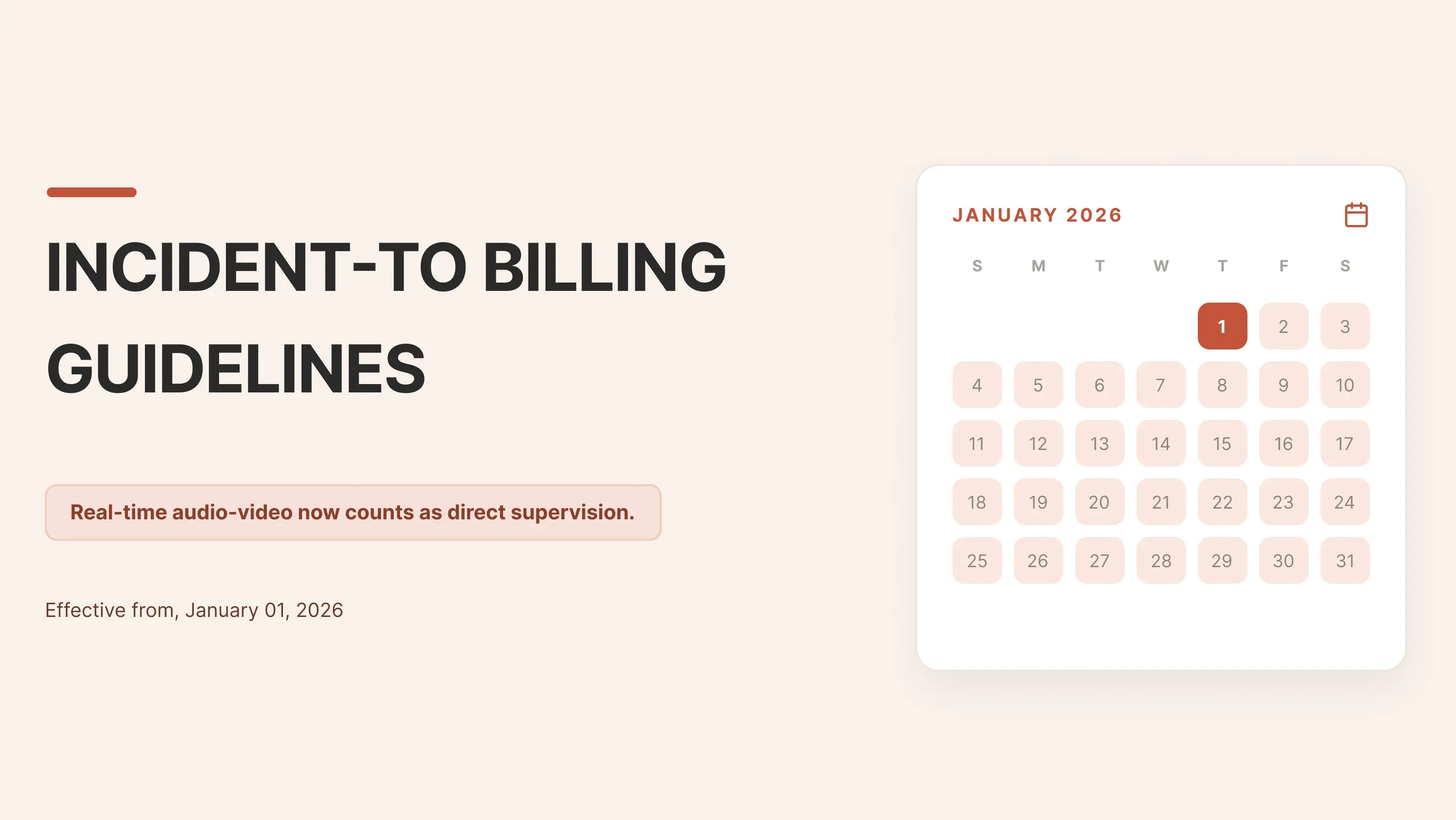
On October 31, 2025, the Centers for Medicare & Medicaid Services (CMS) issued a final rule regarding policy changes to Medicare payments, effective January 1, 2026.
Here’s what the 2026 ruling changes:
-
Virtual Direct Supervision Is Now Permanent
From 2026, CMS permanently allows real-time, interactive audio-video communication to satisfy direct supervision requirements for eligible incident-to services. Audio-only communication does not qualify, and services with global surgery indicators 010 or 090 are excluded from this virtual-supervision policy.
-
In-Person Supervision Is No Longer Required for Every Eligible Service
This rule gives practices more flexibility to supervise qualifying services remotely. Under the new ruling, virtual supervision must be appropriate for the service, and practices must still meet all other incident-to-billing requirements.
-
Core Incident-to-Billing Requirements Still Apply
The 2026 update does not remove requirements related to the established course of treatment, the supervising practitioner's involvement, eligible practice settings, qualified personnel, and documentation. Practices must confirm eligibility before billing under a supervising practitioner's NPI.
Explore More: 2026 Medical Coding Updates for Medical Practices
What Does Incident-to Billing Mean for Small Practices in 2026?
For small medical practices, incident-to billing can help increase Medicare reimbursement when all the requirements are met. The 2026 change, which makes virtual direct supervision permanent, gives practices more flexibility in supervising eligible services. However, the service must still qualify under Medicare rules.
Getting these claims right comes down to accurate documentation, proper supervision, and a billing process that follows Medicare guidelines. PracticeEHR brings practice management, EHR, and medical billing together on a single platform, so small practices can spend less time managing billing tasks and more time focusing on patient care.
FAQs


