

Key Takeaways
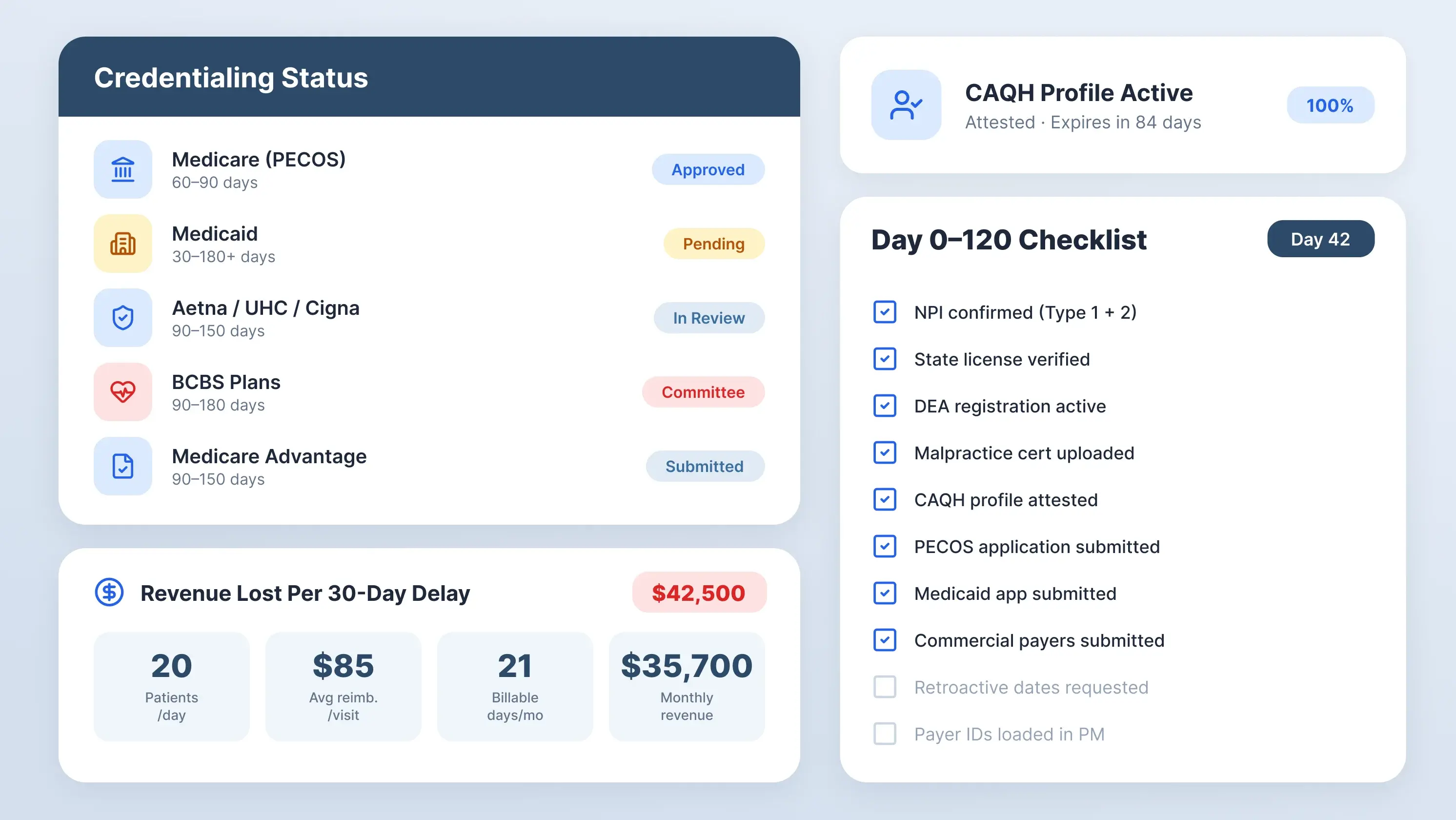
- Plan for 90 to 120 days. Most commercial payers take 90 to 150 days in 2026; Medicare runs 60 to 90 days through PECOS; and Medicaid ranges from 30 to 180+ days, depending on the state.
- Every 30-day delay costs a solo provider around $42,500. Commercial payers rarely backdate effective dates, so revenue lost during the wait stays lost.
- Running credentialing and payer enrollment in parallel can save 45 to 60 days.
- Ask for a retroactive effective date before you sign up. Medicare allows up to 30 days back through PECOS, and some commercial payers will negotiate this at contracting, but only if you ask early.
Provider credentialing takes an average of 90 to 120 days in 2026. Medicare through PECOS runs 60 to 90 days. Medicaid ranges from 30 to 180+ days, depending on the state.
Commercial payers usually land between 90 and 150 days. If you are a new or solo provider, you can start collecting revenue sooner by running credentialing and payer enrollment side by side, requesting a retroactive effective date where the payer allows it, and getting your CAQH profile clean before Day 1.
That is the short version. For the longer version, keep reading to find out more…
Every 30 days of credentialing delay costs a solo provider about $42,500 in unbilled revenue. For higher-paying specialties, the loss is even greater. Most of this delay is avoidable if you know where the process breaks down.
Here is what to expect, why credentialing takes so long, and what you can do to fix it.
Realistic Medical Credentialing Timelines by Payer
Timelines vary by payer, state, and how clean your paperwork is when it lands on someone's desk. The table below reflects what most practices experience in 2026, not the best-case numbers that payers publish.
When we look at the 2026 data above, two patterns show up. First, government payers are more predictable but not always faster. And second, commercial timelines have crept up over the past two years as payers have added various fraud and verification checks.
What Does It Cost a New Practice to Stay Uncredentialed?
Below is the actual math of credentialing wait costs for a new solo provider…
-
20 patient visits a day at $85 average reimbursement = $1,700 a day
-
21 billable days a month = $35,700 in monthly revenue
-
One 30-day credentialing delay = roughly $35,000 to $42,500 gone
-
A 90-day delay = $100,000 to $125,000 gone
For specialty providers, the numbers are even worse. Latest industry data indicates that the average revenue loss for physicians and surgeons during a credentialing wait is around $122,000. That is not money that comes back later. Commercial payers almost never adjust effective dates after the fact, so any patient you saw before the contract start date is either written off or billed directly to the patient.
That is the real cost of a slow application!
Why Does Credentialing Take So Long? 6 Reasons You Should Know!
Before we get to how to speed it up, it helps to understand what actually slows it down. In practice, six things account for most of the delay:
-
CAQH issues
If your CAQH profile is incomplete, missing a document, or has not been re-attested in the last 120 days, every payer that pulls from it will pause.
-
Slow primary source verification
Payers verify credentials directly with your med school, residency programs, licensing boards, or any past employers. Some of those sources take weeks to respond. It's why international medical graduates and providers with overseas training tend to wait longer.
-
Sequential enrollment
Most practices finish credentialing first, then begin the enrollment process. This sequence adds 45-60 unnecessary days to your time-to-billing. So running them together can be the highest-impact change for new practices.
-
Missed committee cycles
Hospital credentialing committees meet on fixed monthly schedules. If you miss the cutoff for any reason, you have to wait an extra 30 days to get considered again.
-
State Medicaid backlogs
State programs vary to a great degree. Some run auto verifications and close applications within days, while others rely on manual review and leave applications on hold for months.
-
Document mismatches
A birthdate that reads one way on your NPI record and another on your CAQH profile can freeze your application. Payers cross-check data across systems and flag anything that does not match perfectly.
Sure, none of these causes is too complex on its own, but together they account for most of the delay.
How to Get Credentialed Faster (What Works And What Doesn’t)
Once a medical credentialing application is in a payer's queue, it moves at their pace, not yours. So most of your leverage sits either before the application goes in, or in things you can do outside the payer's timeline. Here is what works and what doesn’t.
Start 120 days out
Previously, 90 days was a good enough lead time, but commercial payer timelines have stretched nowadays, and the buffer you once had is gone. Give yourself at least 120 days now. If credentialing finishes early, you can start billing sooner. If it finishes on time, you have no gap. Win-win situation in both scenarios.
Get approved by Medicare first, then apply to commercial payers
Commercial payers view Medicare approval as a stamp of legitimacy. Once you are in PECOS, your credentials have already been verified by CMS, which shortens the review commercial payers run on their end.
Do credentialing and payer enrollment in parallel
This is your biggest lever. Do not wait to finish credentialing before starting payer enrollment. Submit both at the same time. Payers can start their review while primary source verification is still in progress. Practices that do this cut their time-to-billing by 45 to 60 days.
The catch here is that you need discipline to track two workstreams at once. Assign one owner, do weekly status reviews, and use a shared docs folder.
Submit to every payer at the same time
Do not stagger applications. If you want to be in-network with six payers, send all six applications at once. Submitting them one by one multiplies your wait time. Sending them together means you wait only once.
Ask for a retroactive effective date
Most new providers are not familiar with this tactic. Medicare through PECOS usually allows an effective date up to 30 days before your application is received, sometimes more for physicians. Some commercial payers will negotiate retroactive effective dates during contracting, but only if you ask before signing. It is not automatic. You have to request it early.
If you get a retroactive effective date, you can bill for services provided during the wait. Most solo providers miss out on this money because they never ask.
Use a supervising or collaborating provider where the state allows
Nurse practitioners and physician assistants can often bill under a supervising physician's NPI during credentialing, depending on state rules and payer policy. This does not work everywhere, but it is worth checking. For NPs and PAs, it can mean weeks of billable revenue you would otherwise lose.
Bill locums under the Q6 modifier for physician gaps
For physicians, a locum tenens lets you bill under the practice's regular provider NPI with the Q6 modifier while the new hire waits for credentialing. There are strict rules, but if you have an established billing provider, this can bridge the gap.
Set clear cash-pay and out-of-network policies for the interim
A number of patients will pay cash, and some out-of-network claims will be processed as well. In both cases, clear disclosures are necessary, along with a written policy, since both arrangements do bring in some revenue while waiting. Although it is unpleasant to set this up, it is a lot better than treating patients free of charge.
Keep CAQH attested every 120 days
Set a calendar reminder for every 30 days. If you miss a single attestation, your profile will be marked inactive, and all payer applications referencing the issue will be resolved. This is the easiest kind of self-inflicted problem to avoid.
Assign one owner
When credentialing is not the responsibility of any one person, it isn't anyone's concern until it becomes a revenue. So assign one individual to check each application weekly, request status updates, and bring any issues to attention as soon as they arise.
You do not have to handle all this yourself. A credentialing partner can manage the paperwork and follow-ups while you focus on patients. Having a reliable and experienced credentialing partner on board can further shorten the timeline.
The CAQH DataSpring Update 2026
If you saw the DataSpring branding earlier this year and wondered whether you need to do anything, the short answer is no. CAQH renamed its parent organization to DataSpring in mid-2026. The provider portal, formerly called CAQH ProView, is now the CAQH Provider Data Portal. Your login, saved profile, documents, and payer authorizations all carried over without any change.
You still attest every 120 days. You still keep your documents current. Payers still pull from the same source. Only the names on the page changed.
Your Day 0 to Day 120 Checklist
Here is what the timeline looks like for a new solo provider planning ahead:
Day 0 to Day 14
-
Confirm your NPI (Type 1 for the individual, Type 2 for the practice)
-
Get your state medical license verified and downloadable
-
Confirm DEA registration and any state-controlled substance registration
-
Order a fresh malpractice insurance certificate
-
Update or create your CAQH Provider Data Portal profile
- Complete PECOS registration for Medicare
Day 14 to Day 30
-
Attest CAQH profile
-
Authorize each target payer to pull your CAQH data
-
Submit the Medicare PECOS application
-
Submit the Medicaid application for your state
-
Send commercial payer applications in parallel (Aetna, UHC, Cigna, Humana, BCBS, and any regional plans you need)
-
Request retroactive effective dates in writing at the contract stage
Day 30 to Day 60
-
Weekly status checks with every payer
-
Respond within 24 hours to any request for additional documentation
-
Confirm primary source verifications are moving
-
Begin hospital privileging application if applicable
Day 60 to Day 90
-
Follow up on any application without a status update in the past 14 days
-
Verify committee meeting dates for slower payers so you do not miss a cycle
-
Prepare your billing system with each payer's provider ID as approvals come in
Day 90 to Day 120
-
Load approved payers into your practice management system
-
Test claim submissions before going live
-
Confirm that eligibility verification is working on the front end
-
Document effective dates for every payer for future revalidation
There can be delays on the payer's end, which can stretch the timeline. The good news is that a credentialing partner can make this entire process much less stressful by handling everything on your behalf.
After Credentialing, Don't Lose the Revenue You Fought For
After the effective dates come into force, the next problem is that claims are rejected on the grounds of eligibility or because of enrollment mismatches. About 15% of clean claims are still rejected at the time of first submission, and a large number of the rejections are due to enrollment or eligibility problems.
So, this is where a modern practice management system earns its keep. Real-time eligibility verification catches coverage problems before the visit. Payer-ID and effective-date tracking prevent the classic mistake of billing the right payer with the wrong provider record. Auto claim scrubbing catches the small errors that trigger denials.
If you are setting up a new practice, this is the point to get the billing infrastructure right. Credentialing makes you eligible to bill. Your PM system determines how much of that eligibility actually results in paid claims.
Ready to bill cleanly from your first approved claim? Book your free call and see how PracticeEHR handles everything from medical credentialing to eligibility verification, claim scrubbing, and payer management for small and mid-sized practices.

.svg)
