

Key Takeaways:
- The right orthopedic EHR should support specialty-specific documentation, coding, billing, and administrative workflows.
- AI-powered tools can reduce documentation time and automate repetitive tasks across orthopedic practices.
- Orthopedic EHRs should offer features such as customized templates, coding support, prior authorization tracking, and integrated RCM.
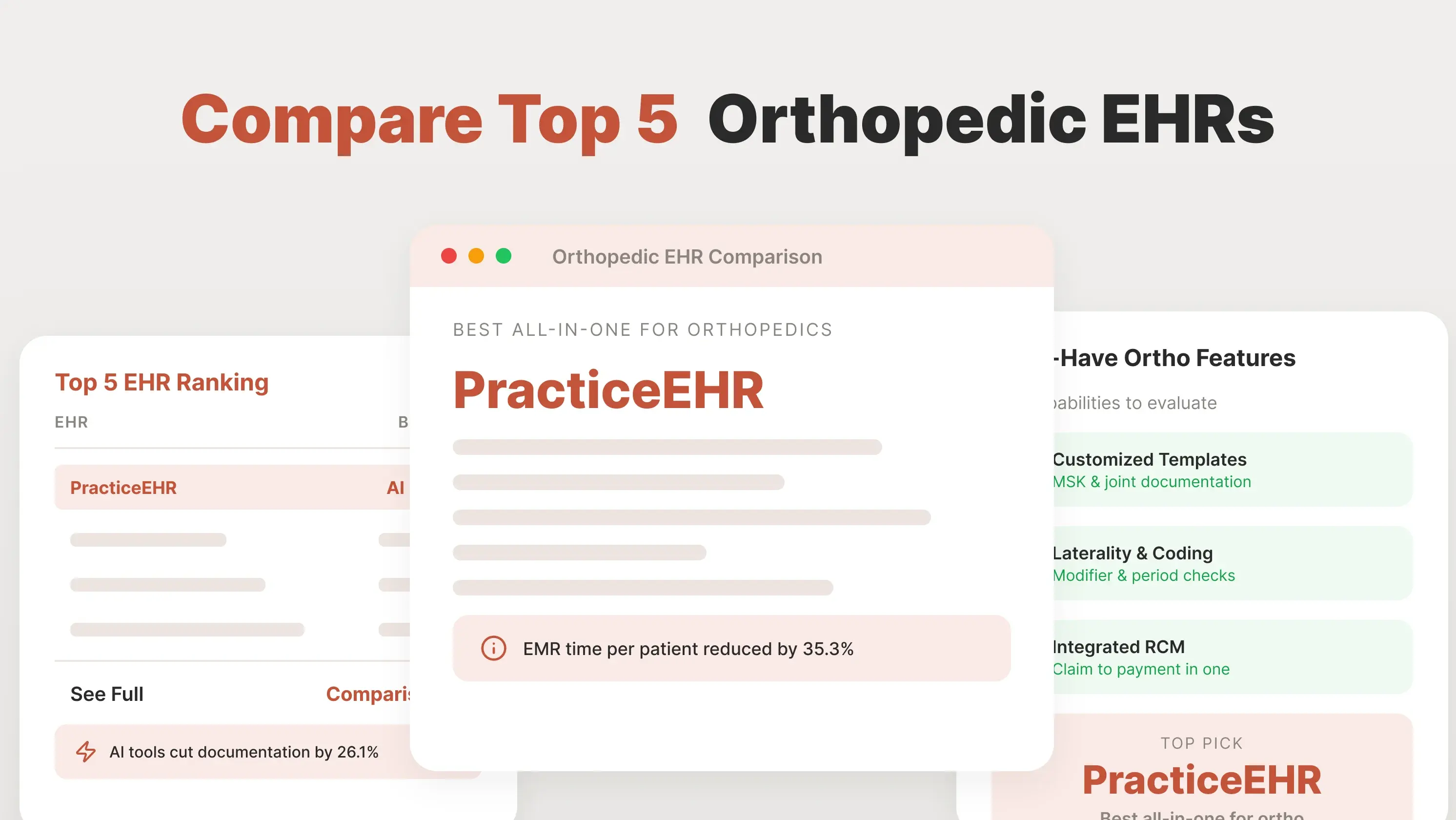
In 2026, Orthopedic practices are increasingly turning to technology to reduce the time spent on documentation and spend more time on patient care. A 2026 study published in the Journal of the American Academy of Orthopedic Surgeons revealed that by using AI-powered tools in an orthopedic clinic, the total electronic medical record time was reduced by 26.1% and EMR time per patient by 35.3%.
The stats highlight that orthopedic practices now prioritize EHR technology that does more than storing patient records. It should help clinicians document faster, keep workflows organized, and spend less time on administrative work.
That makes choosing the right orthopedic EHR especially important for your practice. In this guide, we compare the top orthopedic EHR software options and what each offers for modern orthopedic practices.
What is an Orthopedic EHR Software?
An orthopedic EHR software is an EHR system that is designed for musculoskeletal care workflows. An orthopedic EHR has specialty-specific add-ons like orthopedic templates, musculoskeletal documentation for joints, imaging integration for X-rays, and treatment rehabilitation tracking.
In simple terms, orthopedic EHR software manages the clinical, financial, and administrative workflow of orthopedic practices. Software like PracticeEHR has also integrated specialty-specific tools for musculoskeletal care, imaging, procedures, and treatment documentation.
Best Orthopedic EHR Software at a Glance
The 5 best EHRs for orthopedic practices below are ordered by the practice each one best serves, starting with the strongest all-in-one option. Every entry covers what the platform does well, who it's best for, its standout feature, and pricing.
PracticeEHR opens the list for small- to mid-sized orthopedic practices:
PracticeEHR: Best for AI-Powered Orthopedic Workflows and Integrated RCM
PracticeEHR takes a workflow-first approach to AI-powered orthopedic EHR software, combining clinical documentation, orthopedic coding, orthopedic-specific templates, practice management, and revenue cycle management on one platform.
The main differentiator is its nine-tool AI suite, which can automate many parts of the orthopedic workflow.
- AI Scribe — AI Scribe captures the patient-provider conversation and turns it into structured clinical documentation. The tool works for in-office patients as well as for telemedicine. For orthopedic providers, this can help reduce the time spent documenting examinations, treatment plans, and follow-ups.
- AI Agents — AI calling agents handle your front desk calls like scheduling, rescheduling, cancellations, refills, and patient inquiries. This can help orthopedic practices manage high call volumes without adding more manual work for front-desk staff.
- AI Claim Editor — Catches coding, modifier, and payer-rule errors before a claim is submitted, so more get paid on the first pass. This is particularly useful for orthopedic billing, where issues such as modifiers, laterality, and procedure-specific coding can affect claim payment.
- AI Assist — AI Assist works as an in-system chatbot that guides users through PracticeEHR. For orthopedic practices with new providers or staff, it can reduce the learning curve and make it easier to find and use the right workflows.
- AI Fax — Auto-processes incoming faxes and suggests the document type, so staff do not have to sort them manually.
- AI Scanner —AI Scanner extracts patient information from documents and digitizes it directly into the patient chart. This can make it easier to bring outside records and other paper-based information into an orthopedic patient's digital record.
- AI Show Rate — shows a show-up probability for every scheduled appointment based on multiple factors. Orthopedic practices can use these signals to identify appointments that may need additional reminders or follow-up.
- IVR Agent — A context-aware IVR Agent calls payers to check claim status and chase denials for you. For orthopedic practices, managing complex claims and high-value procedures can reduce the administrative workload on billing teams.
- AI Summarizer — An AI-supported summarizing tool condenses charts, faxes, and labs into readable summaries. For orthopedic providers reviewing a patient's history before an appointment, this can make relevant information easier to find without manually reviewing every document.
Exscribe: Best for Orthopedic-Specific Documentation
Exscribe is an orthopedic-focused EHR designed for practices ranging from small physician groups to large practices. It was developed with input from practicing orthopedic surgeons, administrators, and industry specialists and uses an orthopedic-specific knowledge base and one-click workflow.
Here’s what stands out at Exscribe:
- Orthopedic and sports medicine workflows
- Specialty-specific medical templates
- Clinical workflow and document management
- PACS and practice management integrations
ModMed: Best for Specialty-Specific Orthopedic Workflows
ModMed’s EMA EHR is built specifically for orthopedic practices, with workflows developed around orthopedic documentation rather than adapting a general-purpose EHR to the specialty.
The platform supports customizable treatment plans, suggested E/M and CPT codes, MIPS data collection, imaging, e-prescribing, and interoperability with labs and hospitals.
ModMed’s orthopedics is built around 3 core capabilities,
- Orthopedics-specific templates for orthopedic care and follow-ups.
- Integrated practice management and revenue cycle management for scheduling and billing under the same platform.
- Practice analytics that give the provider an overview of practices' clinical and financial performance.
While ModMed offers these capabilities, reviews on Capterra have highlighted the challenges users faced in billing and insurance processes. It is mainly because ModMed has not integrated AI-powered tools to automate its billing and insurance-related processes.
Athenahealth: Best for Orthopedic RCM and Practice Connectivity
athenahealth's athenaOne for Orthopedics combines EHR, practice management, billing, and patient engagement in an all-in-one platform. Rather than positioning itself solely around orthopedic documentation, athenahealth emphasizes practice efficiency, financial performance, patient engagement, and connections across its healthcare network.
Athenahealth is a particularly useful tool for billing and RCM for orthopedic practices. It is built around three RCM capabilities,
- Built-in claim scrubbing that flags errors in ICD and CPD codes, ensuring clean claims.
- E-verification to check a patient's insurance eligibility against specific procedures.
- Large payer connections to thousands of commercial insurance companies, Medicare, and Medicaid.
But here are a few things you must know. AthenaOne is also not without its drawbacks. Recent reviewers point to several recurring frustrations that practices should weigh carefully before committing:
- The billing team reportedly holds onto claims and sometimes does not follow up.
- Bugs and issues cause frequent crashes, slow responses, and delayed resolutions for critical tasks.
- Excessive clicking is tedious, requiring multiple steps for simple tasks, and slowing down daily operations.
AdvancedMD: Best for Independent Orthopedic Practices
AdvancedMD offers a cloud-based combination of EHR, practice management, and medical billing software for orthopedic practices. Its orthopedic solution is particularly focused on bringing clinical, administrative, and financial workflows into one system.
The core strengths of AdvancedMD for orthopedic practices include:
- Televisit integration for remote consultations and follow-ups.
- Orthopedic-specific templates for ortho-related care.
- Patient portal integration to ensure self-scheduling, patient portal, and secure messaging.
While AdvancedMD offers reliable tools for practice management, recent reviews on Capterra have revealed a pattern of frustration among its users. Its long-term users often complain about the decline of quality over the past two years, with more glitches and unavailable support.
Must-Have Features in an Orthopedic EMR
Before signing for a demo, you should know what you are looking for. Here’s a short list of features to evaluate during your demo:
-
Customized Templates Built for Orthopedic Visits
Orthopedic providers document more than a basic patient history and physical exam. Different conditions, procedures, and body parts require detailed documentation, including laterality and specialty-specific findings.
Look for an orthopedic EHR with customizable templates that can adapt to different orthopedic visits while reducing repetitive data entry. AI-assisted documentation can take this further by drafting notes during the encounter, allowing providers to review and finalize them before moving to the next patient.
-
Orthopedic Coding With Laterality and Global-Period Checks
Orthopedic billing depends heavily on accurate coding. A missed laterality modifier or an incorrectly billed visit during a global period can result in claim rejections and payment delays.
An orthopedic EHR should help identify these issues before a claim is submitted. AI-powered claim editing can review claim lines against payer rules, flag potential coding problems, and identify what needs to be corrected before the claim reaches the payer.
-
Workers’ Compensation and Personal-Injury Billing
Orthopedic practices often handle workers’ compensation, auto accident, and personal injury cases, each with different billing requirements and authorization processes.
Your EHR should support these claim types without forcing your billing team to rely on separate systems or manual workarounds. Look for tools that can manage the appropriate billing rules while tracking authorizations and claim status to help prevent payments from sitting in accounts receivable.
-
AI-Powered Scheduling, Refills, and Patient Calls
A busy orthopedic practice can receive a steady stream of calls for appointments, rescheduling, medication refills, reminders, and other routine requests.
AI calling agents can handle these repetitive front-desk tasks around the clock, while routing more complex requests to staff when needed. This can help reduce the pressure on front-desk teams without slowing down patient communication.
-
Prior Authorization and Referral Tracking
Imaging, surgery, and other orthopedic services may require prior authorization, while referrals can involve multiple steps before a patient reaches the provider.
An orthopedic EHR should make it easy to track authorizations and referrals in one place. Status tracking, visit limits, and centralized worklists can help teams see what is pending and what needs attention before a procedure or appointment.
-
Integrated Orthopedic Billing and Full RCM
Clinical documentation is only one part of running an orthopedic practice. Your EHR should also connect documentation with billing and revenue cycle management.
Look for an integrated clearinghouse, claim editing, denial and appeal support, and dedicated RCM services. Keeping these workflows on one platform can reduce handoffs between systems and give your practice a clearer view of the revenue cycle from claim submission through payment.
See How PracticeEHR Fits Your Orthopedic Workflow
In 2026, choosing the right orthopedic EHR is more than comparing templates and feature lists. Look for an orthopedic system that supports specialty-specific documentation, brings imaging directly into the patient chart, and simplifies surgical workflows.
PracticeEHR brings these capabilities together in one orthopedic-focused platform. PracticeEHR helps orthopedic practices spend less time managing administrative workflows and more time caring for patients. See how PracticeEHR can fit your orthopedic workflow. Book a 60-minute demo today.

.svg)
