

Key Takeaways
- Psychiatry EHRs should support specialized documentation and medication workflows.
- EPCS, PDMP checks, and telepsychiatry are key features for modern psychiatric practices.
- Look beyond monthly pricing and compare billing, telehealth, AI, and other add-on costs.
As a psychiatrist, your EHR shouldn’t be the software that is adding an extra layer of work to your already demanding day. Psychiatric care requires more than standard clinical charting. You need to document mental status examinations, psychiatric histories, and diagnoses while managing patient communication and telepsychiatry from the same system.
That‘s why choosing the best psychiatry EHR software in 2026 requires more than settling for a system with standard charting tools. Reliable psychiatric EHR software should support psychiatric documentation, medication management, and DSM-5-TR diagnoses.
The American Psychiatric Association's Committee on Mental Health IT also published a Psychiatric EHR Functionality Requirements checklist to help practices evaluate vendors. This guide compares the 10 best EHRs for psychiatry in 2026, evaluating their clinical and practice management capabilities for psychiatric practices.
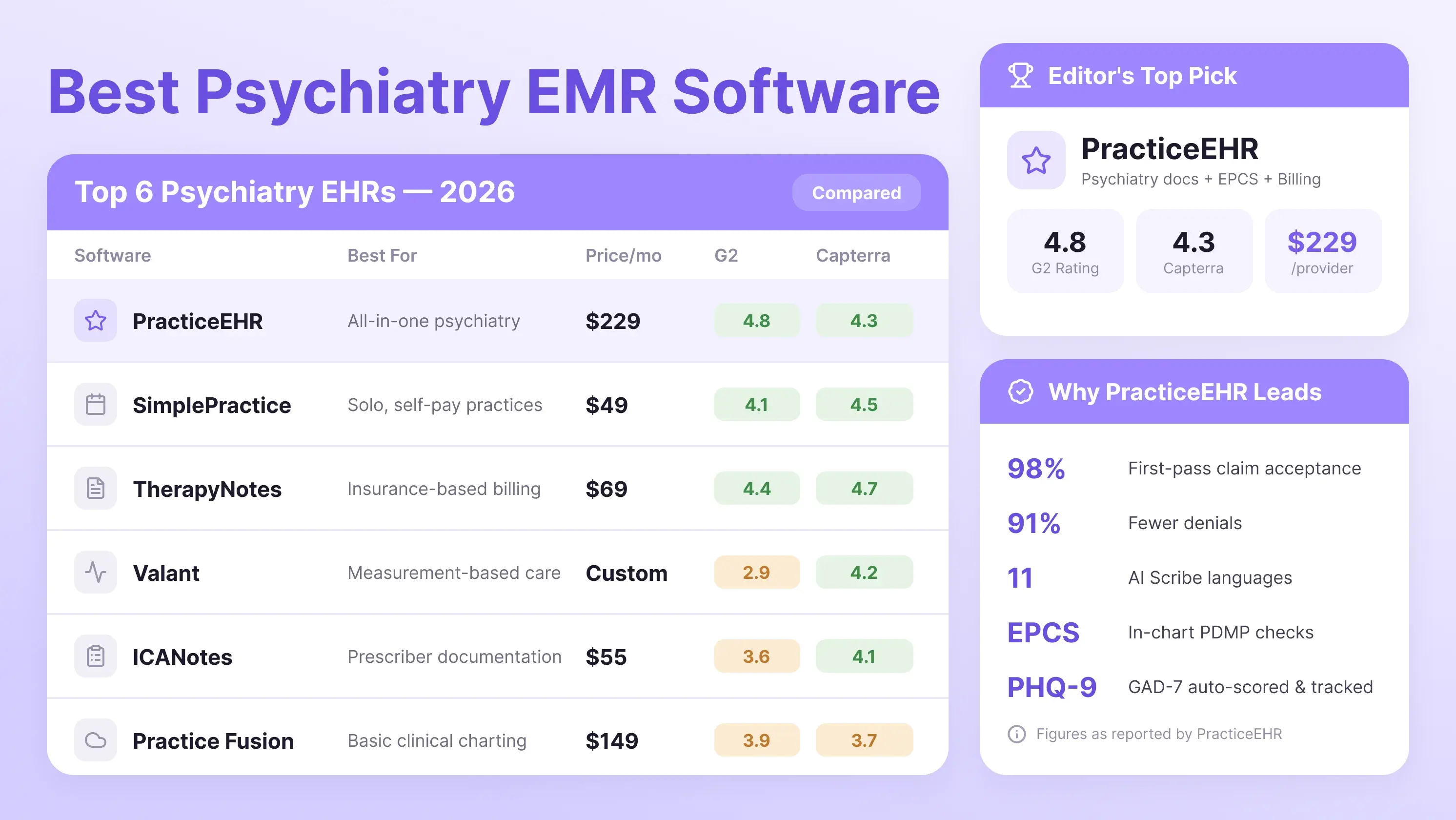
6 Best Psychiatry EMR Software in 2026- Comparison at a Glance
Note: One thing the headline prices hide is that most of these tools sell billing, telehealth seats, and AI notes as separate add-ons, so the entry price rarely reflects what a working practice pays. PracticeEHR includes AI Scribe, TeleVisit, the client portal, and integrated billing in one plan.
How We Evaluated These Psychiatry EHR Softwares
Every platform on the table above can handle basic clinical charting. What sets psychiatric EHRs apart is how well they support workflows beyond the standard progress note, including psychiatric evaluations, medication management, e-prescribing, telepsychiatry, and billing.
We evaluated each EMR using vendor documentation and verified user reviews from platforms such as G2 and Capterra.
Here is what we weighed:
- Support for psychiatric documentation. It includes mental status examinations, progress notes, treatment plans, and customizable psychiatry templates.
- medications, including controlled substances, along with PDMP checks and prescribing workflows.
- Support for screening tools such as PHQ-9 and GAD-7, including administration, scoring, and tracking changes over time.
- Built-in telepsychiatry or integrated video visits, patient access, and tools that support remote psychiatric care.
- Role-based permissions and other controls for protecting sensitive psychiatric notes while giving staff appropriate access.
- Built-in billing and revenue cycle that integrates features such as insurance claims, eligibility, superbills, and other billing capabilities.
- AI and automation: AI-powered documentation, administrative automation, claim support, and other tools that can reduce repetitive work
Rather than ranking these EHRs from best to worst, we grouped them by the types of psychiatric practices they may best serve, from solo psychiatrists and small practices to larger prescribing and multi-provider groups. Use these criteria to narrow your options, then compare the platforms against how your practice documents, prescribes, bills, and delivers psychiatric care.
Comparing the 6 Best EHRs for Psychiatry Practices in 2026
The 6 best EHRs for Psychiatry practices below are ordered by the practice each one serves best, starting with the strongest all-in-one option. Every entry covers what the platform does well, who it's best for, its standout feature, and pricing.
PracticeEHR opens the list for small- to mid-sized psychiatry practices:
-
PracticeEHR: The Best All-in-One EHR for Psychiatry Practices
PracticeEHR is a cloud-based Psychiatric EHR software that integrates psychiatric documentation, practice management, and billing into a single platform. PracticeEHR’s billing is also service-first.
Psychiatric practices must pay a small percentage of their monthly revenue to receive the Elite RCM Package, with the EHR and practice management software included at no additional cost.
Why PracticeEHR is the Best EHR for Psychiatry Practices?
PracticeEHR brings psychiatric documentation, controlled-substance prescribing, measurement-based care, telepsychiatry, and billing together on a single platform, so psychiatrists can manage clinical and administrative workflows without switching between systems.
- EPCS prescribing with in-workflow PDMP checks lets psychiatrists prescribe controlled substances such as stimulants and benzodiazepines while completing PDMP checks directly within the chart.
- AI Scribe captures the visit, transcribes conversations in 11 different languages, drafts structured psychiatric notes, and suggests ICD/CPT codes.
- PHQ-9 and GAD-7 can be sent to patients, automatically scored, and tracked over time to support measurement-based care.
- HIPAA-compliant TeleVisit supports telepsychiatry appointments, with AI Scribe documenting the session and workflows for both remote medication checks and therapy visits.
- Role-based access gives practices control over who can access sensitive psychiatric notes and other parts of the patient record.
- Integrated billing and RCM keep the clinical chart and revenue cycle on a single platform, with the AI Claim Editor reviewing claims before submission. PracticeEHR reports a 98% first-pass acceptance rate and 91% fewer denials.
- Scheduling, reminders, patient self-scheduling, and AI Agents help practices manage appointments, refill requests, and routine patient calls while reducing administrative workload.
Reviews on Capterra pointed to the same strengths of PracticeEHR. AI-powered features at affordable prices, a short learning curve for non-technical users, and 24/7 customer support service make it the right choice for small to mid-size psychiatric practices.
However, PracticeEHR may be less suited to large, multi-location hospitals or health systems that need highly complex enterprise workflows, or large-scale interoperability infrastructure.
Pricing starts at $229 per provider per month, with AI Scribe, TeleVisit, the client portal, and billing included rather than sold as separate add-ons.
-
SimplePractice: Best for Solo Psychiatry Practices
SimplePractice is designed around the needs of small behavioral-health practices, with scheduling, documentation, billing, telehealth, and client communication available on a single platform. Its straightforward interface can make it suitable for psychiatrists who want to manage routine practice operations without a complex EHR setup.
The platform includes customizable documentation, electronic claims, a client portal, online appointment requests, and telehealth. While Simple Practice is praised for its intuitive interface and paperless intake, users have also complained about frequent price increases, long wait times for support, and add-on fees.
Psychiatrists should verify the availability and cost of prescribing features, as well as any add-ons required, before choosing a platform.
-
TherapyNotes: Best for Insurance-Based Psychiatry Practices
TherapyNotes is particularly relevant for practices that rely heavily on insurance reimbursement. Its platform supports customizable notes and treatment documentation, as well as claims and payment workflows.
The best thing about Therapy Notes is their billing capabilities and the support that actually answers their calls. Reviewers on Capterra have lauded fast and knowledgeable US-based phone support. However, the complaints regarding TherapyNotes’ rigid design and thin reporting remain consistent, too.
Overall, TherapyNotes might be a good fit for Insurance-based psychiatry practices that need integrated clinical and billing workflows.
-
Valant: Best for Measurement-Based Psychiatric Care
Valant was initially built by the psychiatrists. It is a behavioral-health EHR designed for organizations that need clinical documentation, measurement-based care, and practice management.
Clinicians who live in outcome data have praised Valant for its best measurement toolkit. Reviewers say that measurement-based care earns the name. Notes and treatment plans shaped around how mental health clinicians think, not a medical template in disguise.
Where it hurts is the financial side, and reviewers have been blunt about this on the software reviewing platforms.
-
ICANotes: Best for Psychiatry-Focused Documentation
ICANotes is built specifically around behavioral-health documentation and supports psychiatrists, prescribers, and other mental-health professionals. It is one of the EHRs that leans heavily on psychiatry and prescriber workflows.
Reviewers on platforms like Capterra value thorough note processing at ICANotes. They also appreciate checkbox and button documentation that speeds up progress notes and assessments. However, new users and non-prescribers face problems due to the steep learning curve.
Therefore, it remains a better fit for psychiatrists who prioritize structured behavioral-health documentation only.
-
Practice Fusion: Best Budget Option for Psychiatry Practices
Practice Fusion is a general-purpose ambulatory EHR rather than a psychiatry-specific platform. We include it because its lower-cost model can appeal to solo psychiatrists who need basic EHR functionality without committing to a specialized behavioral-health system.
The trade-off is specialization. Compared with psychiatry-focused EHRs, Practice Fusion offers fewer behavioral-health-specific workflows for psychiatric documentation, measurement-based care, and specialized billing. Psychiatrists should also verify its prescribing, telehealth, and privacy workflows meet their practice requirements.
Overall, Practice Fusion might be a good fit for budget-conscious psychiatrists who can work with a general-purpose EHR rather than needing specialized psychiatric workflows.
Final Verdict: Choose the Best EHR for Your Psychiatry Practice
There is no single best EHR for every psychiatry practice. The right choice depends on how you document visits, manage medications, prescribe, bill, and see patients. If you run a solo practice and want a simple setup, SimplePractice may be worth considering.
ICANotes is more focused on psychiatric documentation, while Valant puts more emphasis on measurement-based care. If most of your appointments happen online, TheraPlatform may be a better fit for that workflow.
If you want your clinical and administrative work in one place, PracticeEHR brings documentation, prescribing, telepsychiatry, and billing together. Its nine-tool AI suite automates more than half of the psychiatrist’s tasks. It also supports EPCS, PDMP checks, and assessments such as PHQ-9 and GAD-7.
The easiest way to know whether it fits your practice is to see it in action. Book a 60-minute demo to watch AI Scribe create a note while you talk and see how AI Assist can help you complete tasks without leaving the EHR.

.svg)
