

Key Takeaways
- Cloud-based EHRs reduce physician burnout. With anywhere access, physicians will spend less time on paperwork.
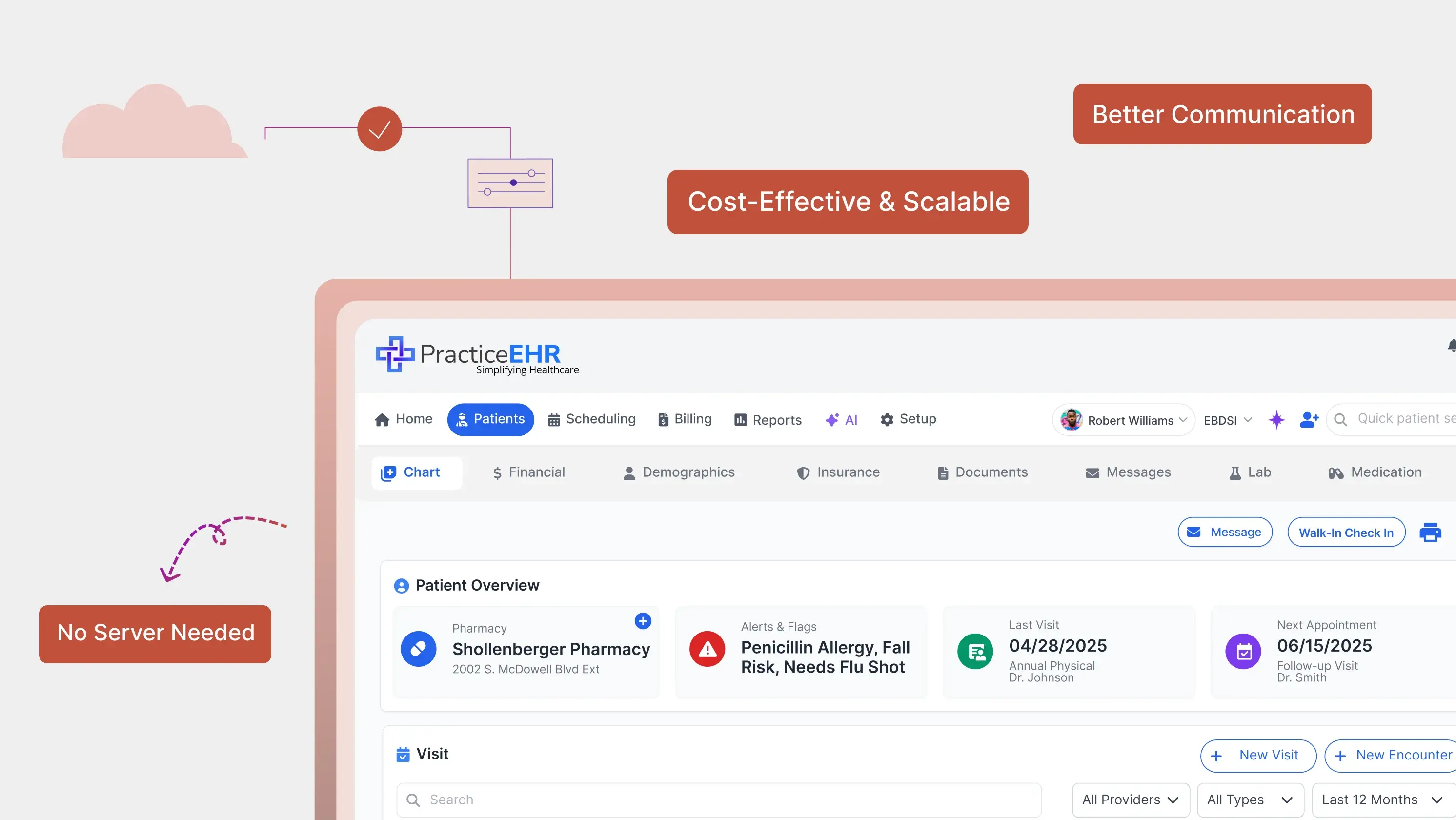
- They’re ideal for small practices. Cloud EHRs are cost-effective, scalable, and eliminate the need for expensive servers or in-house IT.
- The right features like HIPAA compliance, strong clinical functionality, and a user-friendly interface make all the difference.
Are you also one of those physicians who face stressful weekends due to the workload that you couldn’t finish during weekdays? High chances are that you are using a traditional, outdated EHR system that only piles up your work. Many practices without a modern cloud-based EHR still wrestle with downtime, disconnected records, and admin overload.
Cloud-based EHRs allow physicians to gain full access to patient data from the comfort of their home. That is exactly how a cloud-based EHR looks. A recent research of 2024 on the cloud-based EHRs, published by the PwC revealed that 65% of health-services leaders say cloud migration improved decision-making and 58% say it enhanced the patient experience.
How Does a Cloud-Based EHR System Support Small Practices?
Owning a small independent practice is not an easy job! You have to wear the hats of almost all positions while managing your practice. You're working as a clinician, manager, marketer, and HR person. That takes its toll!
In such a situation, if the physician gets burned out, the entire practice suffers. That is exactly where a cloud-based EHR comes into play for small practices. A cloud-based EHR system doesn't keep a physician at once, giving them access even if they are not in the clinic.
Additionally, for small medical practices, cloud-based EHRs streamline the overall practice workflow. Integrated scheduling, patient portals, and automated reminders help reduce front-desk tasks, improve patient engagement, and increase overall productivity.
3 Reasons You Should Consider Cloud-based EHR Software
Why have cloud-based EHRs become increasingly popular? Many small to medium size medical practices who’ve transitioned to this type of software are realizing the benefits. Let’s look at three reasons web-based EHR systems are a great solution for physician practices.
1. Cloud-based EHRs are Cost Effective and Scalable
As a practice owner, you really want to see your practice thrive with the latest technological integration. But with a limited budget, this seems impossible. For example, some studies on the financial implications of EHR show smaller practices spending anywhere from US $15,000 to US $70,000 per provider just for EHR setup. And this is too much for small practices to spend on mere testing.
Cloud-based EHRs are offered as a software as a service (SaaS), meaning practices simply pay a monthly fee to use the software. Practices also don’t have the headache of worrying about updating the system, as updates are made automatically. Additionally, when a practice expands, new users, physicians, or locations can easily be added.
2. No need for a Server-based EHR System
Unlike server-based EHR systems, which are managed by the local hardware, cloud-based EHR systems are hosted on remote servers. Additionally, cloud-based EHRs have much more upfront costs because there’s no need to buy servers, install software, or build in-house IT infrastructure.
Instead, practices pay predictable subscription fees and let the vendor handle maintenance, updates, and security.
3. Cloud-based EHRs Improve Communication
Physicians benefit from cloud-based EHRs because these EHRs provide greater flexibility than ever before. With cloud-based systems, small practices have secure access to their EHR whenever they want, from whatever device they want, as long as there’s internet access.
With cloud-based systems, the practice also has access to important patient information for scenarios that occur outside of office hours, which will help them make more informed decisions for follow up procedures.
Features to Look for in a Cloud-based EHR
When you are looking for a cloud-based EHR, there are a handful of must-have features that you shouldn’t ignore as a physician. Below are a few that will make your lives easier!
Feature#1: HIPAA Compliance for Protecting Your Data
Compliance with healthcare regulatory bodies is mandatory for practices in the United States. One should not consider a cloud-based system that claims to be cloud-based but does not align with the standards of the regulatory bodies.
Physicians often ask us what exactly to look for when choosing a cloud-based EHR system. Here’s the list:
- Data encryption (both at rest and in motion)
- Strong access records
- Backup disaster recovery plans
- Audit trails
Feature#2: Clinical Functionality
Cloud-based EHRs perform multiple functions at once. Imagine your EHR as the central nervous system of a clinic: every beat of patient care pulses through it. At its heart, patient charting captures a patient’s story, from chief complaints to meds and allergies.
Computerized Physician Order Entry (CPOE) replaces chicken-scratch handwriting with precise electronic orders for labs, imaging, and meds, dramatically reducing slips and trip-ups in care delivery. Together, these features shave hours off documentation, boost clinician efficiency, and tighten the safety net around patients.
Feature#3: User-Friendly Interface for Fast Adoption
Here’s what you might be missing: you (and your team) will only get value from your cloud EHR if it has better usability. If it’s clunky, slow, and hard to navigate, you’ll end up going against the system rather than it working for you.
One of the most important features while considering an EHR is the user-friendly interface. The EHR would be useless if it did not help users with their work. For that, they need to have an EHR that allows a physician to:
- Check how many clicks it takes to get common tasks done.
- Ask for a demo with you doing real-life tasks (e.g., looking up medication, lab results, ordering).
- Ask about support/training; how long until your team becomes proficient?
- Check if the interface supports mobile/tablet use (might matter in a cloud-based scenario).
Such an EHR shortens the steepness of the learning curve. This allows the practice to thrive without significant interruptions.
Switch to Cloud-based EHR to See Your Practice Thriving
At the end of the day, physicians want to see their practices thrive. Integrating cloud-based EHRs is not only a tech upgrade but your ticket to breathing room. Cloud EHRs bring life to your practice by providing remote access and automating most of the documentation process.
Practice EHR brings you the best cloud-based features to make your practice thrive throughout the year. Tried and trusted by over 42,000 providers across the US, Practice EHR is now leading healthcare tech innovation with its latest AI features.

.svg)
