


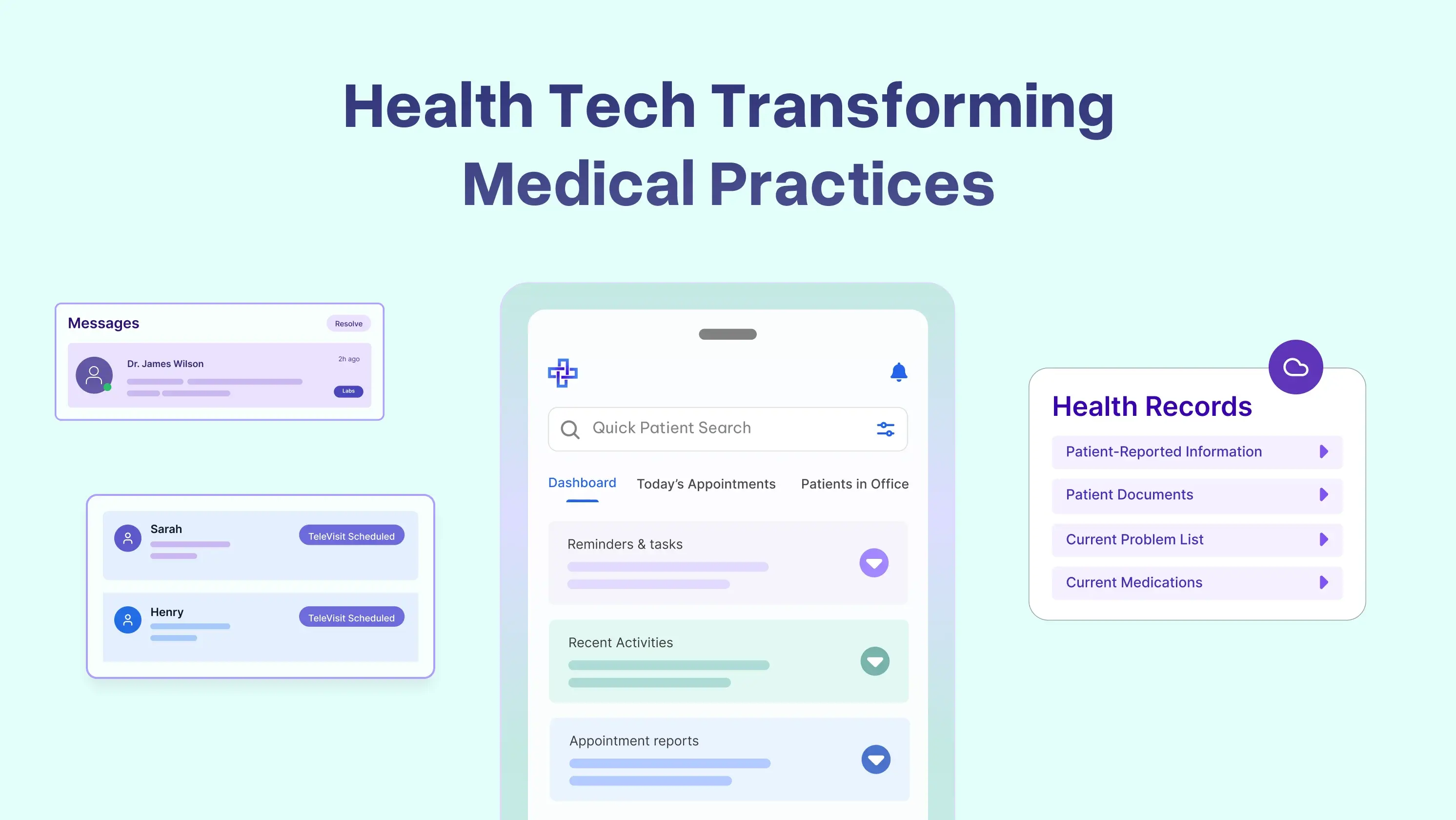
 Imagine walking into your clinic tomorrow, and despite getting bogged down by the paperwork, you simply tap into your system and get all the details you need. No more shuffling through your notes, no more missing lab reports, and, of course, no more billing discrepancies.
Sounds like a dream, right? But for many physicians, the reality today feels far from that: administrative overload, delayed reimbursements, claim denials, and the constant friction of outdated workflows.
However, the best part is embracing digital health, specifically via a strong, feature-rich EHR. Switching to digital healthtech can resolve these pain points, and not just marginally but transformationally.
In this blog, we’ll explore why digital health matters, how a powerful EHR enables true digital care, and what specific EHR features make the difference!
Key Takeaways
- Digital health is no longer an option but a necessity of contemporary healthcare challenges.
- Platforms like EHRs, patient portals, telemedicine, and cloud-based access have truly transformed the way healthcare is being delivered now.
- With advanced health tech tools, modern EHRs help you reclaim your time, improve patient care, and build a practice that thrives.
The Digital Health Imperative: The Core to Modern Medical Practice
Digital health is no longer an option but a necessity of contemporary healthcare challenges. It's not about replacing doctors with machines but incorporating technology to assist providers. Platforms like EHRs, patient portals, telemedicine, and digital apps can help your practice grow with no inefficiencies blocking the progress.


Why Does Digital Health Matter So Much in 2026 and Beyond?
Listed below are a few points that elucidate the importance of technology in healthcare to deliver better patient care in the modern era:
- Improved Quality & Safety: A study on Digital platforms, such as EHRs, revealed that they reduce medication errors, alert users to critical lab values, and support evidence-based decision-making. In one study, a large proportion of physicians reported that EHRs helped prevent medication errors and flagged critical lab results.
- Patient Engagement & Empowerment: With patient portals and secure messaging, patients can see their test results, communicate with you, schedule visits, and actively participate in their care. These features boost trust, compliance, and satisfaction.
- Data-Driven Medicine: EHRs generate a wealth of data. Practice managers can analyse trends, identify gaps in care, and improve over time. On a systemic level, this allows for reflective practice and continuous quality improvement.
Despite concerns about cost, complexity, and learning curves, the evidence strongly favors digital health. As practice managers, embracing it is not just about efficiency: it's about reclaiming time lost to manual documentation, improving patient outcomes, and strengthening your practice’s foundation.
Digital-First Care: Why a Strong EHR is the Backbone?
To unlock the power of digital health, you need a system that goes beyond basic charting. A strong EHR is one that enables top-notch digital care, not just electronic storage.
Here are the features that make the difference!
- Integrated Telehealth & Documentation: Instead of using separate tools, a reliable EHR integrates telehealth with charting and medical billing, making continuity seamless.
- Real-Time Access & Collaboration: Clinicians, nurses, and care teams can access the same data, coordinate care, and use shared workflows.
- Billing & Revenue Cycle Tools: A powerful EHR helps you speed up reimbursements by automating claims, providing coding assistance, and managing denials.
- Patient Engagement Embedded: With patient portals, secure messaging, and self-service features, patients become active participants in their own care.
- Analytics & Decision Support: Using built-in data tools, practice managers can derive insights, reflect on performance, and guide practice improvements.
If your EHR lacks these capabilities, you may only be scratching the surface of what digital health can do for you.
EHR Features That Fuel True Digital Care
Here are the essential EHR features that empower medical practices to shift to digital-first care for better staff satisfaction, optimal patient care, and efficient operations:

1. Cloud-Based EHR Storage: The Foundation of Flexibility
Cloud-based EHRs are developed to make digital health more accessible, even when providers are miles away from the clinic. Here’s how cloud-based EHRs promote accessible care:
- Scalability & Agility: Cloud infrastructure scales with your practice, whether you're expanding locations or adopting new services. You don’t need massive on-site servers or IT overhead.
- Anywhere Access: Whether you're on your mobile device, in the clinic, or at home, you can securely access patient data in real time.
- Interoperability & Integration: Cloud-based systems often support modern digital data standards (e.g., FHIR), enabling smoother data sharing across systems.
- Reduced Burnout & Data Overload: Cloud systems can leverage advanced filtering, AI solutions, and manageable inbox workflows to reduce alert fatigue and cognitive load.
- Security & Compliance: Modern cloud EHRs prioritize encryption, access control, audit logs, and compliance frameworks, ensuring patient data remains protected.
2. Practice Management Tools: Running Your Clinic With Digital Precision
Integrated practice management tools in your EHR streamline operations, reduce staff burden, and create a more patient-friendly experience.
- Patient Kiosks: In-office digital check-in stations enable patients to complete registration, update their demographics, and fill out intake forms directly into the EHR. This cuts down front-desk load, reduces data entry errors, and speeds up workflows.
- Scheduling: When your appointment system is integrated into the EHR, you can better manage both in-person and telehealth slots, avoid overbooking, and send automated reminders. That means fewer no-shows and a smoother day-to-day clinic with digital tools.
- Patient Portal: Patients can now log in to see their health information and lab results from the comfort of their home. They can schedule follow-up visits, request prescriptions, or review treatment plans.
- Secure Messaging: A HIPAA-compliant messaging system within the EHR allows providers to communicate with patients asynchronously. Whether they're asking about lab results, clarifying symptoms, or requesting refills, secure messaging is faster, safer, and avoids unnecessary phone traffic.
3. Billing & Revenue Optimisation: Because Care Should Be Sustainable
A digital-first EHR like Practice EHR isn’t just for clinical work. It must also support the financial health of your practice.
- Integrated Clearinghouse: The EHR should directly interface with a clearinghouse, automating claims submission, checking payer rules, and tracking the status of claims. This reduces manual steps and accelerates cash flow.
- Medical Billing & Coding Tools: Coding assistance built into the EHR can suggest the correct ICD, CPT, or HCPCS codes based on your documentation. This reduces human error, increases first-pass claim acceptance, and aligns documentation with billing.
- Claims Denial Management: Intelligent EHR systems don’t just submit claims. They analyze denial patterns, help prepare appeals, and flag recurring errors. Over time, this can significantly reduce denials and improve your revenue cycle.
Real Transformation: How Health Tech Has Changed Medical Practice
For years, physicians have been dealing with the daily grind of paper charting, misplaced lab results, and fragmented communication. Your practice must be facing technical issues, too, due to outdated manual systems. Limited access to data also makes it arduous to track your patients' health status and understand care trends.
Today, healthcare is rapidly evolving. With fully leveraged EHRs and integrated digital health tools, medical practices can thrive on seamless and cloud-based workflows. Care teams collaborate effortlessly on a shared platform, referrals move in real time, and billing becomes far more accurate and predictable. The administrative fog lifts, giving physicians back time and operational clarity.
Most importantly, patients are now also engaged partners in care. Portals, messaging, and transparent access to records empower them to take charge of their healthcare. Data dashboards also help you identify gaps, strengthen clinical performance, and improve outcomes.
This isn’t a future promise. It’s the daily experience of digitally enabled practices around the world. Here’s a brief comparison of healthcare before and after the introduction of digital healthtech tools.
|
Category |
Without Digital Healthtech |
With Digital Healthtech |
|
Medical Records |
Paper charts, misfiled documents, fragmented notes |
Cloud-based EHR with instant access across devices |
|
Care Coordination |
Faxed labs, verbal updates, and delayed specialist communication |
Integrated, real-time communication and workflows |
|
Billing and Revenue Cycle |
Manual claims, frequent denials, labour-heavy appeals |
Automated claims, coding support, and faster payments |
|
Patient Engagement |
Limited access to records, low involvement |
Portals, messaging, scheduling — empowered patients |
|
Clinical Insight |
Minimal analytics, hard to track quality metrics |
Dashboards, reports, and data-driven decision-making |
Embrace Digital Health With Practice EHR
For you, the dream of running a thriving practice must be simple: meaningful patient interaction, excellent care, and better cash flow. But the realities of paperwork, fragmented systems, and financial stress often pull you away from that vision.
Adopting digital health via a reliable EHR isn’t just a tech upgrade; it’s a renewal. To bring your dream of innovation to reality, Practice EHR brings you advanced AI-powered solutions. Our EHR features are exactly what physicians and practice managers are looking for in the modern digital era.
With advanced health tech tools, Practice EHR can help you reclaim your time, improve patient care, and build a practice that thrives. Request a free demo today to learn more about our features!
FAQs

