
Key Takeaways
- AI significantly reduces administrative workload for physicians, so they focus more on patient care.
- Predictive analytics and personalized treatments improve patient outcomes while lowering post-treatment expenditure.
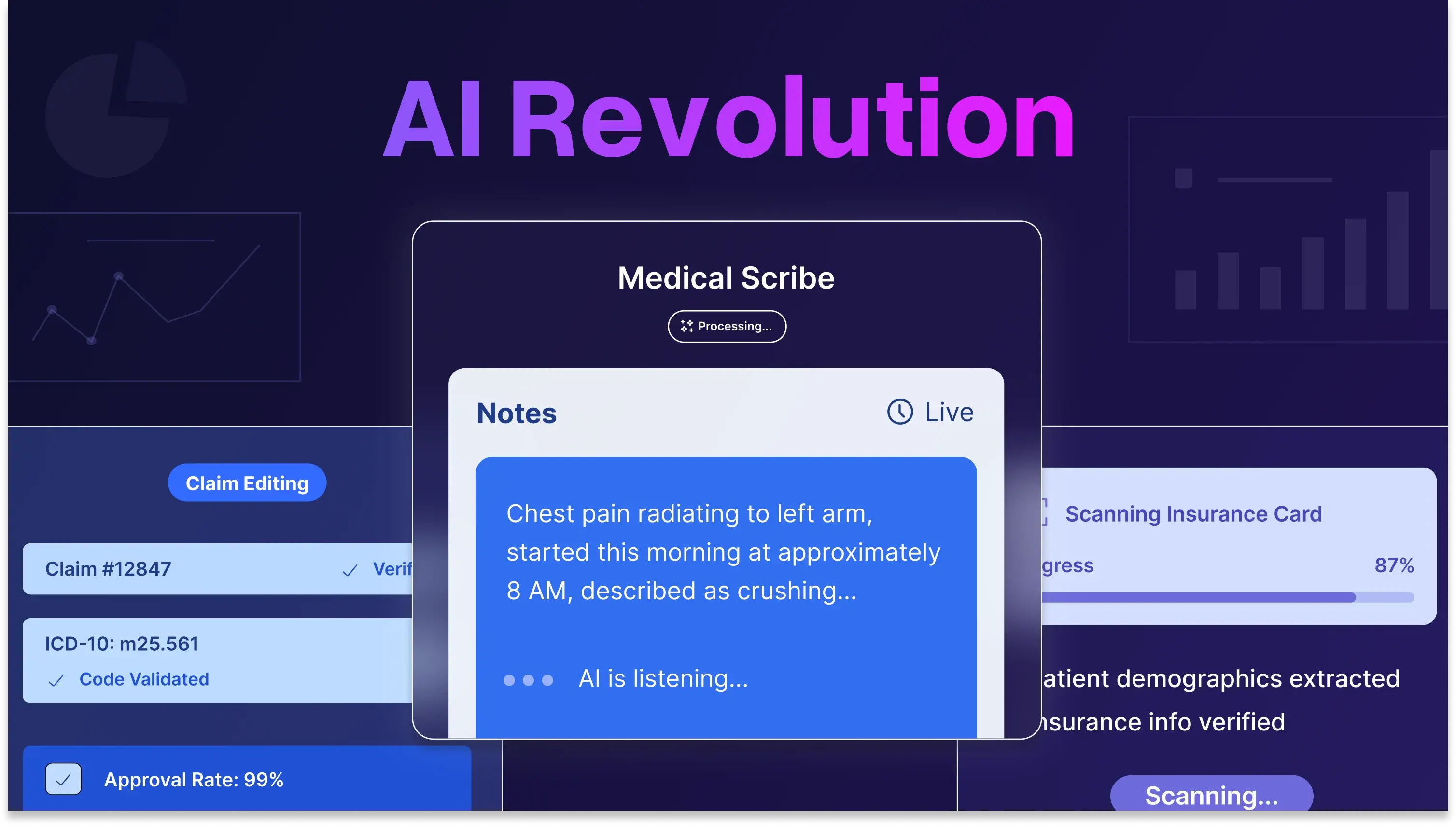
- AI-powered EHR features like scanning, scribing, and claim editing streamline workflows and reduce errors.
One of the benefits of AI in healthcare is relieving paperwork. Did you know that, according to the Medscape Physician Compensation 2023 report, physicians spend an average of 15.5 hours a week on administrative tasks? Doctors often complain that paperwork hinders their medical services and fails to ensure a streamlined workflow.
Imagine scheduling an appointment with your doctor, but on visiting, you find him busy with administrative tasks. Thus, the paperwork becomes the biggest hurdle in your check-up, compromising your healthcare.
In such circumstances, AI healthcare applications have the potential to bridge the gaps and revolutionize the global healthcare system. Here, we explore the increasing role of AI-powered EHR features in healthcare!
Benefits of AI in Healthcare
AI benefits in healthcare can give you several medical, administrative, economic, and social benefits. Let's discuss some of the key benefits of AI in healthcare!
1. Relieving Administrative Workload
A recent report by the World Health Organization suggests that the global healthcare system is expected to reach a shortage of 11 million healthcare workers by 2030. This implies that few physicians will be available in your hospitals who will not only provide patient care but also manage the administrative workload.
This problem provides considerable impetus for AI healthcare applications. The AI-supported documentation tools can now create a summary of the patient-provider conversation, which is then saved in the patient's health records for the future.
AI in healthcare benefits physicians, alleviating their workload. AI-powered tools perform routine tasks such as scheduling, documentation, and claim editing in less time. AI helps save time and labor for physicians, ultimately improving patient care.
2. Prediction of Risks and Diseases
The benefits of AI in healthcare have proven significant in various ways. For instance, in cardiology, AI techniques are widely used to detect the early stage of congestive heart failure and improve patient risk assessment of arterial diseases.
AI healthcare applications also include leveraging big data for an early risk assessment to predict diseases. For instance, Google collaborates with health delivery networks to develop prediction models that alert clinicians to high-risk illnesses like sepsis and heart failure.
Machine learning models built on AI technologies can also predict the populations at risk of particular accidents or diseases. Moreover, AI algorithms such as deep learning assist in disease classification and enable more patient-centered healthcare.
3. Reduces Posttreatment Expenditures
AI-powered systems can also benefit you economically by analyzing post-treatment result patterns and identifying effective remedies based on a patient's medical records. Such a personalized approach can significantly reduce the cost associated with posttreatment procedures.
AI advantages in healthcare also include the development of personalized treatment plans by analyzing genetic makeup, medical history, and lifestyle. This is one of the AI healthcare applications that increases the effectiveness of the treatment, reducing unnecessary hospital stays and ultimately cutting down expenditures.
The benefits of AI in healthcare are not limited to patients or physicians; they also optimize hospital and laboratory management systems.
AI-powered predictive analytics can forecast patient flow, helping hospitals allocate staff and resources more effectively, reducing waste, and improving care delivery.
Pros and Cons of AI-Powered EHR Optimization Tools for Healthcare Organizations
AI-powered tools integrated in EHR have several benefits for physicians. Below is the list of pros and cons the tools can have for private practices.
Pros of AI-Powered EHR Optimization Tools
-
Alleviates physician burnout
-
Automates documentation
-
Accurate claim submissions
-
Enhances patient engagement
-
Faster Reimbursements
Cons of AI-Powered EHR Optimization Tools
-
Initial implementation cost
-
Staff training requirements
-
Data privacy concerns
-
Dependence on technology
-
Integration challenges

A Glance at AI Use Cases in Healthcare!
AI is revolutionizing healthcare, and it is worth investing in AI-powered EHR optimization for medical practices because it personalizes treatment plans, improves clinical decision support systems, and provides telehealth platforms. Such AI use cases in healthcare have given a new dimension to the healthcare system.
1. Personalized Treatment Plans
Personalized treatment plans are designed using strategies that focus on an individual rather than a one-size-fits-all approach. This feature is AI-driven and creates customized plans that consider genetic makeup and lifestyle factors.
In such treatment plans, personalized medicines play a pivotal role in utilizing data from various sources, such as previous medical records, imaging results, and genetic information.
The application of personalized medicine is likely to improve patient care and lower expenditures as well. Thus, the process turns out to be one of the best healthcare AI use cases.
2. AI in Robotic Surgeries
In the era of AI, the advent of Automated Performance Metrics (APM) has revolutionized surgical healthcare. APMs rely on kinematic and video evaluation and serve as objective, actionable, and real-time assessment tools. Combining APM with ML can produce objective assessment metrics of surgeon performance. Such healthcare AI use cases are developing robust healthcare technology.
While integrating AI into robotic surgeries, ethical considerations must be preserved. Developing ML models for robotic surgery requires large-scale data sharing across multiple institutions. Using a standardized method to anonymize data from data collection to data usage is critical for privacy protection.
3. AI in EHR
The advantages of AI in healthcare go beyond hospitals and laboratories. Electronic Health Record (EHR) systems can process massive amounts of patient data by leveraging AI tools, leading to effective healthcare management. AI-EHR is one of the best examples of healthcare AI use cases.
Benefits of AI in EHR systems include streamlined workflow, providing treatment recommendations, and enhancing physician-patient interaction. An AI EHR system can be a great relief when a physician does not have to write every word of their patient's conversation manually.
Common AI in EHR examples include AI scanning tools, AI claim editors, and AI ambient scribes, which can summarize and transcribe physician-patient discussions, ensuring a streamlined workflow.
This novel and rapid transformation of AI healthcare applications is pivotal in improving healthcare and streamlining workflow, reducing doctor burnout, and optimizing the efficiency of AI EHR.
AI Solutions in PracticeEHR
In the era of traditional EHRs, PracticeEHR stands out as your ONE AI-powered solution. PracticeEHR promises to provide the benefits of AI in healthcare systems, which can improve patient care to a great extent. You can now simplify your manual paperwork and let PracticeEHR's AI tools take over the documentation process.
1. AI Scanner
The AI Scanner feature of PracticeEHR successfully removes the hassle of manual paperwork, streamlining the workflow with automation. With PracticeEHR's AI Scan, a document goes from scan to fully populated in less than 5 seconds.
2. AI Scribe
AI Scribe from PracticeEHR can transcribe the conversation between you and your patient while you listen to your patient with focus. It generates structured clinical notes for later use. AI-powered solutions for EHR documentation templates provide a meaningful connection with your patients by avoiding lengthy typing and distractions.
3. AI Claim Editing
The AI Claim Editor from PracticeEHR evaluates claims ready for submission for discrepancies and errors. Once it identifies any claim errors, it will alert the user to make necessary changes before submission. This way, PracticeEHR can help you reduce claim returns and denials.

Future of AI in Healthcare
Data suggests AI healthcare applications will expand substantially over the next decade. Researchers predict that it will grow from a global marketplace value of almost $27 billion in 2024 to more than $613 billion by 2034. AI for medical practice growth helps healthcare organizations improve operational efficiency and enhance patient satisfaction.
Switch to an AI EHR if you also want to explore how artificial intelligence healthcare applications and healthcare AI use cases improve patient care and ease the administrative workload burden for your practice.
FAQs

.svg)
